18 Signs Your Crawl Space Needs Encapsulation
Your house is already telling you what's happening underneath it — you just have to know how to read the signs. Here's what each one means and how urgently to act.
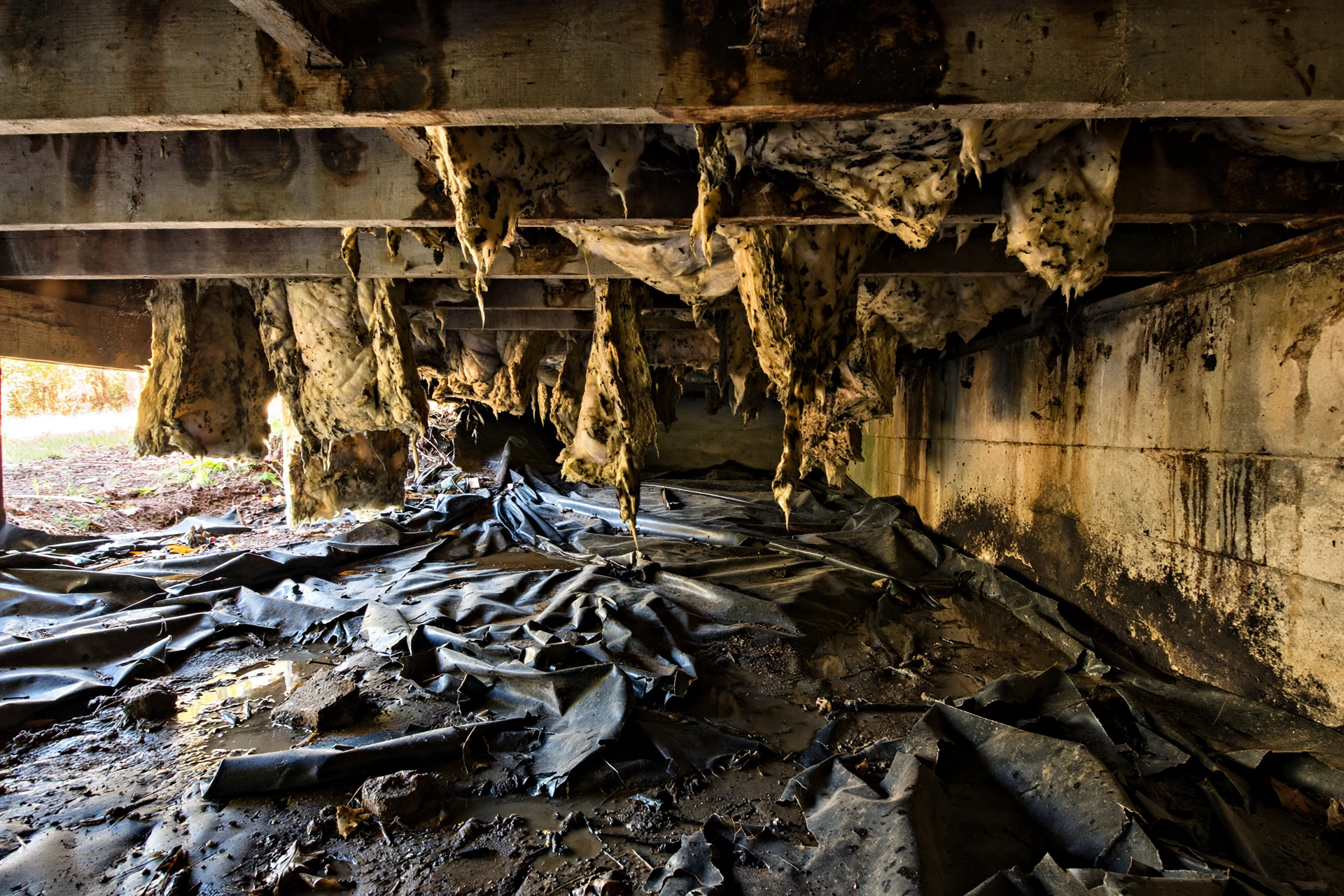
Most Hoover homeowners never go under their house. That's fine — the house reports upward. Moisture problems in the crawl space show up as smells, floor changes, energy bills, and things you can spot from the yard. We've grouped all 18 signs by where you'll notice them, with an honest urgency rating on each: act now, schedule soon, or keep an eye on it.
Inside the House
Roughly half the air on your first floor starts in the crawl space and rises through the stack effect. When something's wrong down there, the living space is usually where you notice it first.
A musty or earthy smell that won't go away
The classic tell. If the smell is strongest when you walk in after being away, or on humid days, the source is almost certainly below you. Air fresheners and candles mask it; they don't fix it. This is the sign that brings most of our customers to us.
Soft or bouncy spots in the floor
Flooring that gives underfoot near tubs, toilets, or exterior walls means the subfloor or joists beneath are compromised — usually moisture-softened wood. This is structural, not cosmetic. Get eyes under the house before it gets worse; subfloor replacement gets expensive fast.
Cupped or warped hardwood floors
Hardwood cups when the underside absorbs more moisture than the top — moisture rising from a damp crawl space is a prime suspect in Hoover homes. If your floors are cupping and there's no plumbing leak, look down, not around.
Indoor humidity you can't get under control
AC running constantly but the house still feels sticky, condensation on windows, a thermostat that says 72° but feels like 78° — when the crawl space pumps humid air upward all summer, your HVAC fights a battle it can't win. Encapsulation typically drops indoor humidity noticeably within the first week.
Doors and windows that stick seasonally
Wood framing swells and shifts with moisture cycles. If interior doors that worked fine in winter start sticking every summer, the framing is moving with humidity — and the crawl space is the humidity engine. This one often gets misdiagnosed as a foundation problem.
Energy bills creeping up year over year
A damp crawl space forces your HVAC to dehumidify as well as cool — damp air is harder and more expensive to condition. If your summer bills keep climbing with no change in rates or usage, the crawl space is a suspect worth checking. Sealed systems typically cut HVAC costs around 15%.
In the Crawl Space
If you do venture under the house — flashlight, mask, and someone who knows where you are — here's what you're looking at.
Standing water or persistent mud
Puddles after rain that linger for days, or soil that never fully dries. This is the single most urgent sign: water destroys everything it touches given time, and no encapsulation system goes in until drainage handles it. If you see this, the conversation starts with a French drain, not a vapor barrier.
Visible mold on joists, subfloor, or piers
Black, green, or white fuzzy growth on wood framing. Surface mold on a few joists is remediable; widespread growth with wood discoloration means it's been there a while. Either way, it gets remediated before anything is sealed — we never encapsulate over mold.
Rotted or crumbling wood on sills and joists
Probe suspect wood with a screwdriver. If it sinks in easily, that's rot — the structural stage of a moisture problem. This moves the job from encapsulation into repair-then-encapsulate territory: sister or replace the damaged framing first, then seal.
Sagging, fallen, or wet insulation
Fiberglass batts hanging like wet laundry between joists have absorbed moisture and stopped insulating. They're also holding that moisture against your floor framing. In a sealed system, floor insulation comes out and wall insulation goes in — but the sagging batts are the symptom that gets you there.
Condensation ("sweating") on ducts and pipes
Water beading on ductwork or cold-water lines means warm humid air is hitting cool surfaces — the physics of every vented crawl space in a Hoover summer. It drips onto the ground and the cycle continues. This is the sign that a vapor barrier alone won't fix; the air itself needs managing.
Pest evidence: droppings, tunnels, nesting material
Moisture draws everything: termites need it, rodents nest in damp insulation, and standing water breeds insects. Pest control treats the animals; encapsulation removes the habitat. If your pest tech keeps finding activity, ask what's attracting it.
Rusted hangers, straps, and nail heads
Orange rust on joist hangers, duct straps, or nail heads is a slow-motion moisture gauge — it takes sustained humidity to rust galvanized hardware. Not an emergency by itself, but it's telling you the space runs wet.
Outside Clues
You can read a lot about a crawl space without going under the house. Walk the perimeter after a heavy rain.
Soil grading toward the foundation
Ground that slopes toward your house funnels every rainstorm directly to the foundation wall. Shelby County's red clay makes this worse — it swells, holds water against the wall, and hydrostatic pressure pushes it inside. Grading is the cheapest fix in this entire guide and the most skipped.
Gutters overflowing or dumping at the foundation
A single downspout dumps hundreds of gallons next to your foundation in a hard Hoover rain. If gutters overflow, or downspouts end two feet from the wall, all that water is heading under your house. Extend them ten feet out before you spend a dollar on anything else.
White mineral stains (efflorescence) on foundation walls
That chalky white crust on block or concrete is mineral deposit left behind as water migrates through the wall and evaporates. It's proof of water movement through your foundation — the wall is wicking moisture, and the crawl space behind it is breathing it.
Mulch or soil piled above the foundation line
Landscaping beds built up against the house bridge the gap between soil and siding — and sometimes cover the foundation vents entirely. Pull mulch back below the siding line and keep vents clear. Free fix, real impact.
Foundation vents blocked by vegetation or debris
Overgrown shrubs and leaf buildup sealing off vents trap humid air inside (in a vented system) or signal that nobody's paid attention to the crawl space in years. Clear them — and while you're at it, consider whether it's time for someone to look under there.
What To Do With This List
One sign? Note it and check again in a few months. A or two? Worth a professional look — that's what our free inspection is for. Any ? Don't wait for it to become two s. Water damage compounds: today's $4,000 drainage job is next year's $12,000 drainage-plus-mold-plus-repair job.
And the honest footnote: some of these signs have other causes. Sticking doors can be foundation settlement. High bills can be an aging HVAC. We'll tell you when the crawl space isn't the problem — we'd rather lose a job than sell you the wrong fix.