Crawl Space Drainage & Sump Pump Installation in Hoover, AL
Interior French drains, properly sized sump systems, and exterior grading — engineered for Shelby County's expansive red clay and the hydrostatic pressure it creates.
Everything about water management in a Hoover crawl space starts with the ground itself. Shelby County's red clay doesn't behave like sandy or loamy soil — it swells dramatically when wet, shrinks when dry, and holds water against your foundation with a persistence that surprises homeowners from other parts of the country. If your drainage system wasn't designed for this soil, it wasn't designed for your house. Here's the engineering, without the jargon.
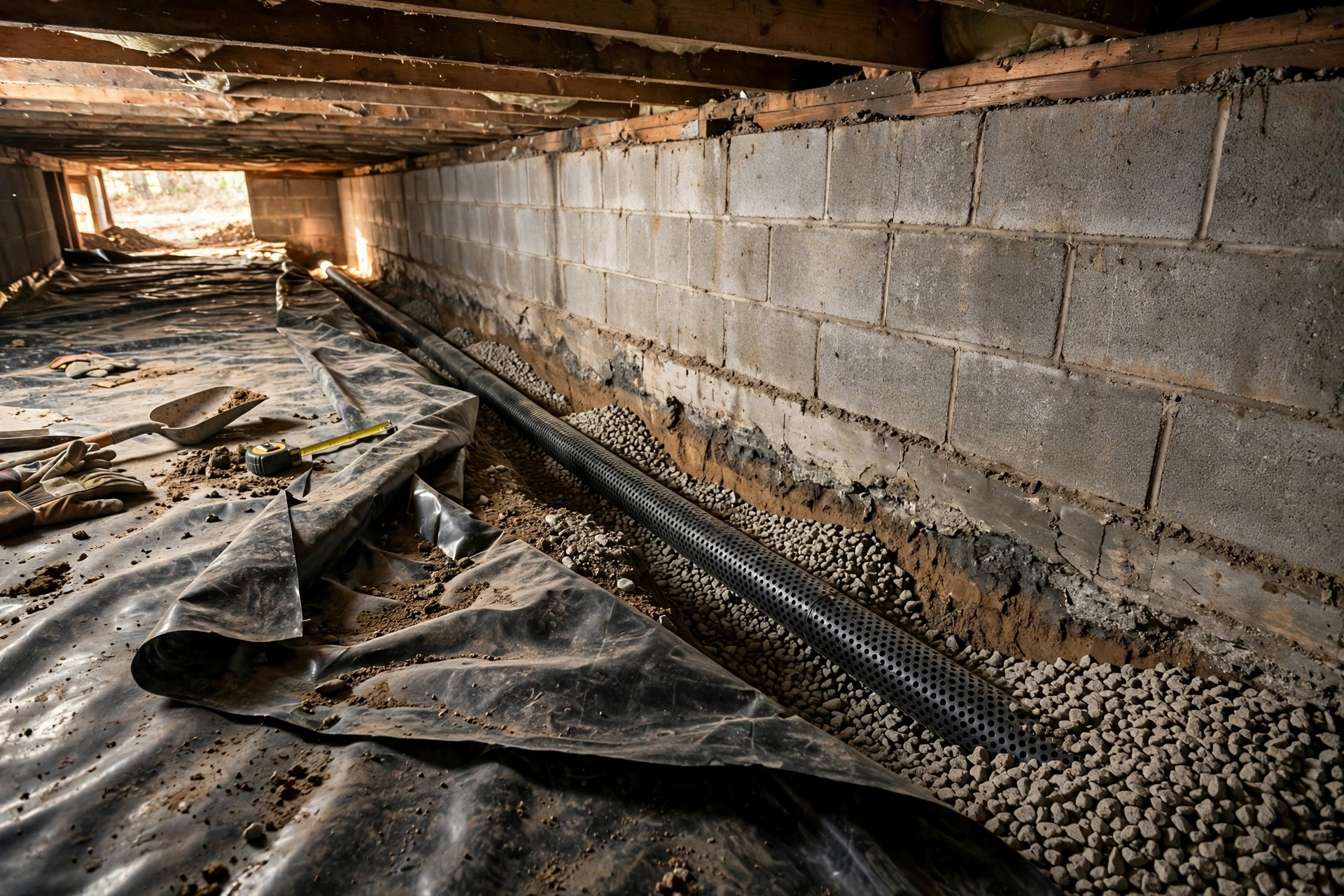
How does an interior French drain actually work?
An interior French drain is a perforated pipe bedded in washed stone, installed in a trench along the inside of your foundation footing. Water migrating through the soil hits the stone bed — which drains far faster than clay — enters the pipe through its perforations, and flows by gravity pitch to a sump basin. It's a preferential path: water follows the easy route instead of pooling on your crawl space floor.
The details that determine whether it works for decades or fails in five:
- Placement at the footing: the trench runs alongside the interior footing, at or slightly below footing level — because that's where hydrostatic pressure delivers water. A drain installed too high misses the water table; too deep undermines the footing. We excavate to the right depth and no further.
- Washed stone, not pea gravel: the pipe beds in clean washed stone (typically 3/4-inch), which maintains void space for water flow. Fine gravel or crusher run packs down and clogs — in clay soil especially, the stone must stay open. We wrap the assembly in filter fabric to keep clay fines from migrating in.
- Continuous pitch to the basin: the pipe slopes steadily toward the sump — no bellies, no flat spots. Water doesn't flow uphill, and standing water inside the pipe breeds the sediment that eventually clogs it. We check pitch with a level as we lay, not by eye.
- Full perimeter (usually): water doesn't politely enter from one side. In clay soil, pressure acts on the entire foundation. Partial drains leave unprotected wall sections that become the new entry points. We drain the full perimeter unless the site assessment shows a genuinely localized source.
The trench gets backfilled with stone to floor level, leaving a clean floor with only a discreet basin lid visible. The system works silently underneath through every storm.
Every crawl space we work on gets a thorough assessment first. We document moisture levels, structural condition, and drainage patterns before recommending a solution — so you get what your home actually needs, not a one-size-fits-all package.
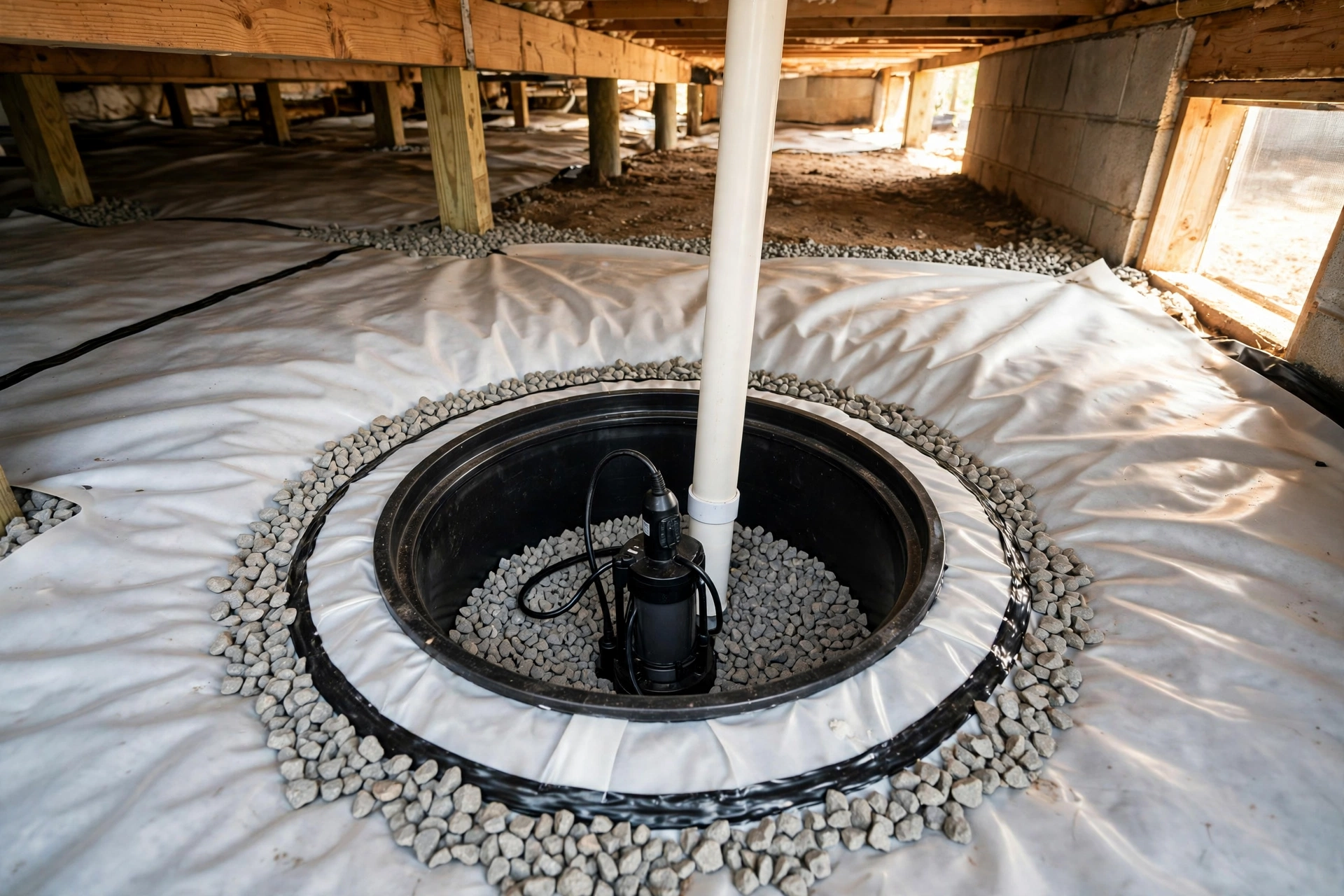
How do you size a sump pump — and what if the power goes out?
We size by water volume and lift height: most Hoover homes need a 1/3 HP primary pump moving 2,000–3,000 GPH at the actual discharge head. High-water sites get 1/2 HP. And yes — you need a plan for outages: a battery backup pump (6–12 hours of runtime) or a water-powered backup where municipal water pressure allows.
Sizing is where cheap installations fail. Here's our approach:
- Measured, not guessed: during the inspection we assess your water volume — staining lines on the foundation, soil saturation, history of intrusion depth. A home that gets two inches of standing water needs a different pump than one with damp soil.
- Head height matters: pump ratings are quoted at zero lift; real installations lift water 8–15 feet to the discharge point. A pump rated 3,000 GPH at 0 feet might deliver 1,800 at 10 feet of head. We size for your actual lift, not the brochure number.
- Basin sizing: 18-inch diameter minimum — smaller basins cause short-cycling that kills motors. Large or L-shaped footprints may need two basins.
- Vertical float switches instead of tethered ones — tethered floats hang up and stick on (burnout) or off (flood).
On power outages: Hoover's worst water events arrive with the storms that knock out power. Battery backups (deep-cycle battery + secondary pump) carry 6–12 hours of intermittent pumping — enough for most outages. If your power blinks every thunderstorm, backup isn't optional.
What about water coming from outside the foundation?
Surface water is the cheapest problem to fix and the most commonly overlooked. Before any interior work, we check grading (soil should fall 6+ inches over the first 10 feet from the foundation), downspout discharge (10+ feet from the house, not at the corner), and gutter capacity. Fixing an $800 grading problem beats installing a $6,000 drain to manage it.
The exterior checklist, in order of cost-effectiveness:
Gutters and downspouts
A 1,500 sq ft roof sheds nearly 1,000 gallons in a 1-inch rain. Extensions carrying that water 10+ feet from the foundation are the highest-ROI fix in waterproofing.
Grading
Soil should fall 6+ inches over the first 10 feet from the foundation. Negative grading is surprisingly common in Hoover subdivisions where landscaping beds have been built up against the house over the years.
Surface drainage
Yard drains intercept surface flow before it reaches the foundation — useful for sloped lots or uphill neighbors draining onto you, common in Greystone's rolling terrain.
Interior drainage
For water that still reaches the footing despite the above — the water table, the clay's hydrostatic push. The interior French drain is sized for what exterior measures can't stop.
We recommend exterior fixes first when they're the actual problem. Less revenue for us; the right answer for you.
Why is Hoover's clay soil so hard on foundations?
Shelby County red clay is expansive: it absorbs water and swells with tremendous force (exerting thousands of pounds of lateral pressure per square foot against foundation walls), then shrinks and cracks as it dries — opening pathways for the next rain. This swell-shrink cycle repeats every wet-dry season, stressing foundations continuously in a way sandy soils don't.
Most soil lets water pass through. Clay holds it, swells, and pushes — creating hydrostatic pressure against your foundation. That pressure peaks after sustained rain when the soil is fully charged: exactly when your crawl space is most vulnerable.
Fall and early winter deserve special attention: after summer the clay is at its driest and most contracted, so the season's first heavy rains deliver water straight through those shrinkage gaps to your foundation wall. Dry all summer, wet every fall? That's the clay cycle — and interior drainage is the answer.
What Does Crawl Space Drainage Cost in Hoover?
Complete drainage systems in the Hoover area typically run $3,500–$8,000:
| Drainage scope | Typical range |
|---|---|
| Sump basin + 1/3 HP pump (localized water) | $1,800 – $3,000 |
| Full-perimeter interior French drain + sump | $4,500 – $8,000 |
| Dual-basin system (large/complex footprint) | $7,000 – $10,000 |
| Battery backup add-on | $800 – $1,500 |
| Exterior grading / downspout correction | $800 – $2,500 |
What drives it: linear feet of drain (perimeter length), number of basins, pump sizing, discharge distance and routing difficulty, and soil conditions — our clay is harder digging than loam, and tight crawl spaces slow the trench work. Battery backup is quoted as a separate line so you can decide based on your outage history, not our revenue goals.
Common Questions About Crawl Space Drainage
How long does an interior French drain last?
30+ years with washed stone and filter fabric. The pipe doesn't wear out — drains fail from sediment clogging, which fabric and proper pitch prevent. The sump pump (7–10 years) is the maintenance item, not the drain.
Early killers: sediment infiltration from wrong stone or no fabric, flat spots collecting silt, root intrusion at discharge. Annual check: verify the pump cycles and discharge flows.
Where does the sump pump discharge the water?
Well away from the foundation — 10+ feet minimum, ideally to daylight at a lower grade or to a storm drain where permitted. Discharging at the foundation corner just recycles the water back into the soil against your wall.
We see this mistake constantly: a pump working perfectly, discharging three feet from the house, running forever because it's pumping the same water in a loop. Discharge routing is part of the system design, not an afterthought — and in Hoover, we check local requirements on storm drain tie-ins before assuming.
Will a French drain lower the water table under my house?
It manages water at your foundation — it doesn't lower the regional water table, and it doesn't need to. The drain intercepts water migrating toward your footing and routes it away before it can pool or pressurize. That's the entire job, and it's enough.
Anyone promising to "lower your water table" is overselling. What the system does — reliably, for decades — is keep water from accumulating where your house meets the ground. The water table does what it does; your crawl space stays dry regardless.
Can drainage be installed in a tight crawl space?
Yes, down to about 18 inches of clearance — below that, it gets into specialized-equipment territory. Most Hoover crawl spaces run 24–48 inches, which is workable. Tight spaces take longer (hand digging instead of trenchers) and cost more, but they're very doable.
We'll measure your clearances during the inspection and quote accordingly — no surprises. If access is genuinely too tight for interior work, we'll discuss exterior options honestly rather than forcing a bad installation.
Do I still need drainage if I'm getting full encapsulation?
If there's any history of standing water or active intrusion: absolutely yes — drainage goes in first, then the encapsulation seals over a dry space. If the space has never taken on water and moisture readings are clean, drainage may be unnecessary.
This is the "drainage first, then seal" rule in action. The inspection determines which category you're in: water history means drainage is non-negotiable; a clean dry history means we can skip it and say so. Either way, the encapsulation quote reflects the honest assessment, not a package deal.
Engineered for Clay, Not Generic Soil
Our free inspection evaluates your soil conditions, water entry points, and grading — then designs drainage for what your house actually sits on. No generic systems, no skipped steps.
- Water entry points mapped and photographed
- Grading and downspouts checked first
- Pump sized for your volume and lift
- Battery backup quoted separately, honestly
Prefer to talk? (205) 208-7286