Crawl Space Mold Removal in Hoover, AL
Your inspector found mold — here's what that actually means, how professional remediation works, and why killing the mold without fixing the moisture is money down the drain.
Few phrases spike a homebuyer's blood pressure like "mold in the crawl space" on an inspection report. Take a breath. Crawl space mold in Hoover is extraordinarily common — our climate practically manufactures it — and it's fixable. But it's fixable correctly or not at all, and the difference is whether anyone addresses the moisture feeding it. This page walks through what the inspector found, what remediation actually involves, and the order of operations that keeps it from coming back.
Your inspector found mold — what now?
Don't panic, but don't ignore it either. Get a professional assessment of extent (surface growth vs. deep colonization), cause (the moisture source feeding it), and framing condition (whether wood is stained or structurally compromised). Then remediate the mold, treat the wood, fix the moisture source, and verify with post-remediation moisture readings.
Inspection reports vary wildly in how they describe mold, so let's decode the language:
- "Microbial growth observed on floor joists" — the inspector's careful way of saying mold. Extent unknown from the report alone; needs eyes on it. Could be light surface growth or something deeper.
- "Elevated wood moisture readings (XX%)" — the number matters more than the mold word. Above 20% sustains active growth; 16–19% is the warning zone; under 16% is generally safe. Ask for the actual readings at multiple points.
- "Recommend evaluation by qualified contractor" — standard language meaning "beyond my scope to quantify," not "your house is doomed." We photograph the extent, meter moisture, check framing, and price a real remediation scope.
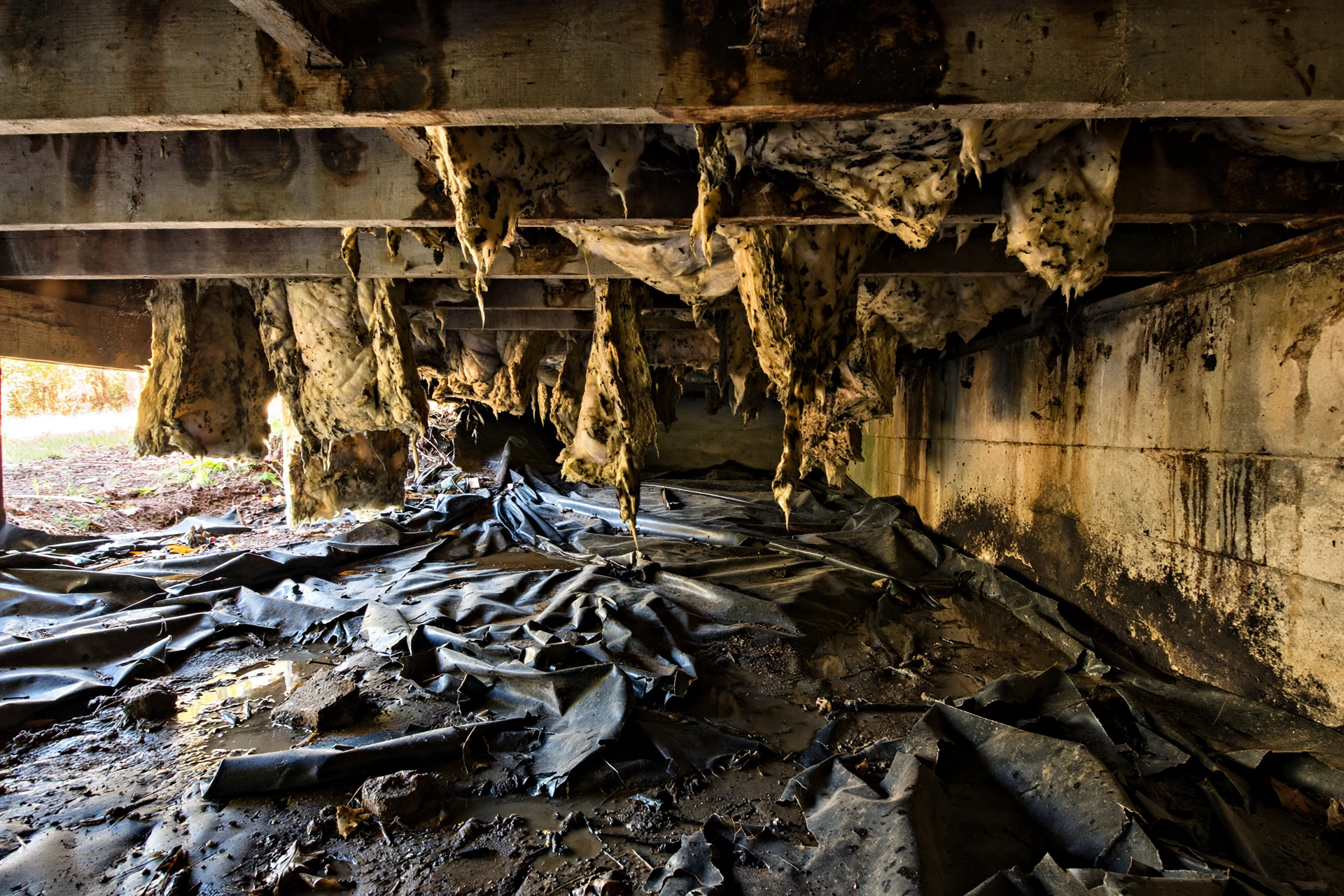
- "Wood decay / fungal damage" — stronger language suggesting the mold has progressed to rot. This crosses from remediation into structural repair territory and needs prompt attention.
If you're buying: mold in the crawl space is a negotiation point, not a dealbreaker — get a remediation quote (we provide them free) and factor it in. If you're selling: addressing it before listing removes the buyer's leverage and the deal-killing delay. Either way, the worst move is hoping the next inspector won't look down there. They will.
Every crawl space we work on gets a thorough assessment first. We document moisture levels, structural condition, and drainage patterns before recommending a solution — so you get what your home actually needs, not a one-size-fits-all package.
How is crawl space mold actually remediated?
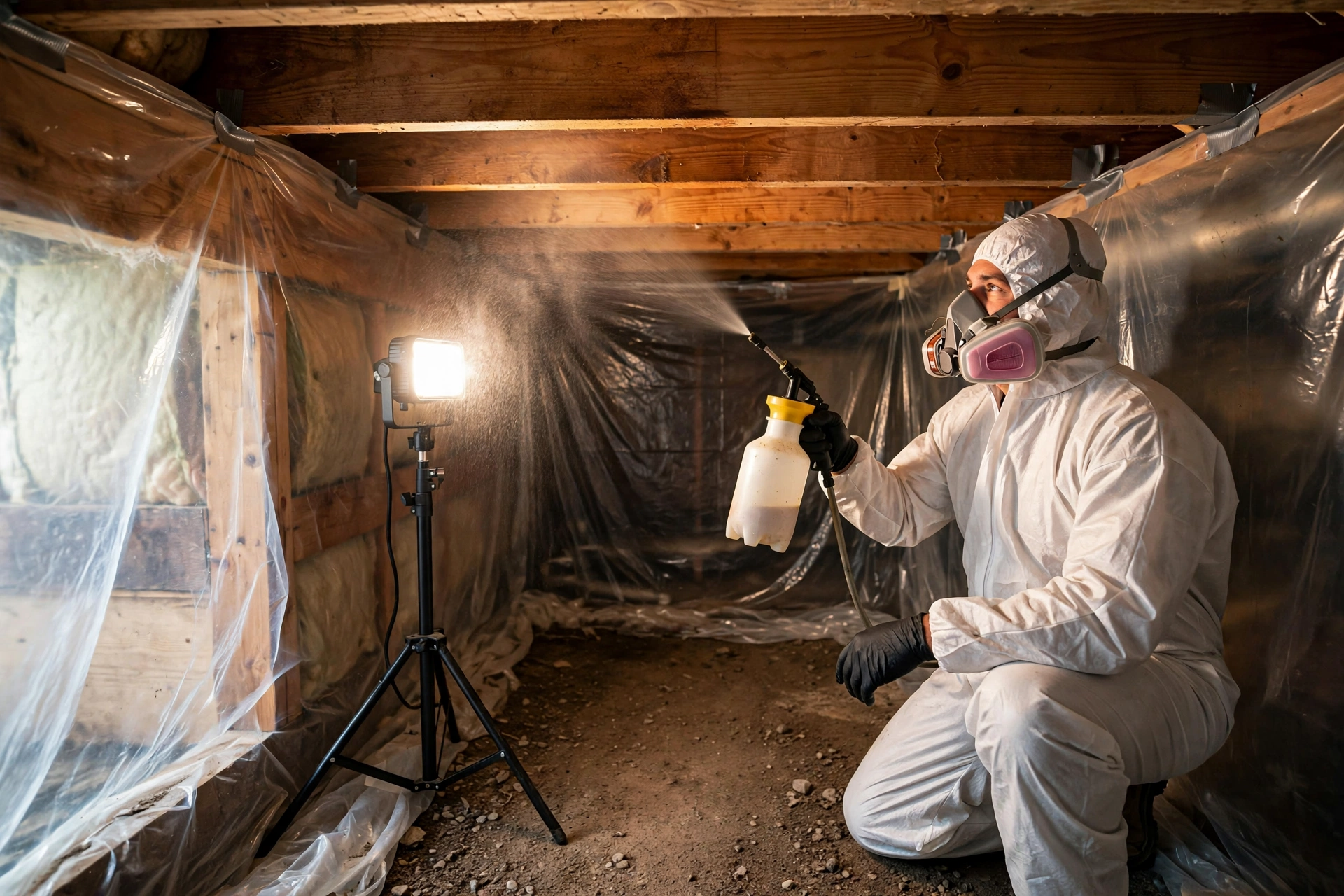
Professional remediation follows a sequence: contain the work area, remove debris and failed materials, HEPA-vacuum surfaces, apply antimicrobial treatment to kill growth, treat wood with a borate-based preservative, and remove the contamination from the space — not just kill it in place. Then fix the moisture source so it can't return.
The details matter more than the chemicals:
Assessment and containment
We document the extent with photos, meter moisture everywhere, and check whether framing is stained or compromised. The work area gets contained so spores don't migrate into the living space during remediation.
Removal before treatment
Fallen insulation, debris, failed vapor barrier — anything harboring growth comes out first. You can't effectively treat surfaces buried under contaminated material.
HEPA vacuuming
All framing surfaces get HEPA-vacuumed to physically remove spore loads. Killing mold without removing it leaves the allergen load in place — dead mold is still an irritant.
Antimicrobial application
EPA-registered antimicrobial applied to all affected wood. This kills the growth — but it's step four, not step one, because chemicals can't do the job of physical removal.
Borate wood treatment
A borate-based preservative penetrates the wood and provides residual protection against future fungal growth and wood-destroying insects. This is the long-term armor, not just the kill.
Moisture source correction
The step that determines whether this was remediation or theater. Drainage, dehumidification, ventilation correction — whatever the moisture meter says the space needs. Then post-remediation readings to prove it.
What we don't do: fog with chemicals and call it done. Fogging without removal or moisture correction is air freshener in a damp basement — it smells like action. It isn't.
Will killing the mold solve the problem?
No — not by itself. Mold is a symptom; moisture is the disease. Kill every spore in the space and leave the humidity at 75%, and you'll have mold again within a year. Permanent results require remediation plus moisture control: drainage for water, dehumidification for humidity, sealing for infiltration.
This is the single most important paragraph on this page, so let me be blunt: any mold quote that doesn't include a moisture-control plan is incomplete. We've remediated spaces where a previous company "treated" the mold twice — same growth back both times — because nobody addressed the 72% relative humidity feeding it. The third visit (ours) fixed the moisture. The mold hasn't returned.
The honest sequence is always: remediate, then control moisture, then verify. In practice that usually means mold remediation as phase one of an encapsulation project — clean the wood, then seal and dehumidify the space so the conditions that grew the mold can't recur. Quoted together, sequenced properly, warranted as a system.
A note on health: we're crawl space contractors, not doctors. What we can tell you factually is that mold produces spores and microbial volatile organic compounds (the musty smell), that 40–50% of your first-floor air comes from the crawl space, and that removing the growth and the moisture that feeds it removes the exposure source. For health questions, talk to your physician — we'll handle the building.
What about termite inspections after mold remediation?
Standard practice: leave a 3–4 inch inspection gap between the top of any wall barrier and the sill plate, so WDO (wood-destroying organism) inspectors can see the wood they need to see. If you have a termite bond, tell your provider about the remediation and any encapsulation that follows.
There's a real interaction here that sloppy contractors ignore. Termite inspectors in Alabama need visual access to the sill plate and band joist — the exact area where wall vapor barrier terminates. A barrier run all the way to the top plate looks tidy and blocks the inspection, which can void your bond's inspection compliance. The 3–4 inch gap is the professional standard that satisfies both moisture control and inspection access.
Also worth knowing: the borate treatment we apply during remediation doubles as a deterrent to wood-destroying insects. It doesn't replace your termite bond — keep that active — but it's a meaningful secondary layer. And post-remediation, with the space dry and accessible, future WDO inspections are actually easier than they were in a dark, damp, moldy crawl space.
What Does Crawl Space Mold Remediation Cost in Hoover?
Mold remediation in Hoover crawl spaces typically runs $1,500–$9,000 — the widest range of any service we offer, because extent varies enormously:
| Remediation scope | Typical range |
|---|---|
| Light surface growth, small area, no structural involvement | $1,500 – $3,000 |
| Moderate growth across joists, full HEPA + antimicrobial + borate | $3,000 – $6,000 |
| Extensive colonization, debris removal, possible framing repair | $6,000 – $9,000+ |
What drives it: square footage of affected area first, then whether framing is compromised (rot moves it into structural repair), then accessibility. And critically: the moisture-control work that follows (drainage, dehumidification) is quoted separately — remediation without moisture control is the expense that repeats itself. When we scope mold as phase one of encapsulation, you see both numbers and the logic connecting them.
Common Questions About Crawl Space Mold
Is black mold in the crawl space dangerous?
Color doesn't determine danger — "black mold" is a colloquial term, not a species identification, and lab testing is the only way to identify what's growing. What matters for your decisions is extent, moisture source, and whether it's affecting the living space.
Don't let anyone upsell or dismiss based on color. The professional response is identical regardless: assess, remediate, fix the moisture. For medical or legal species identification, use an independent tester — never the remediation company.
Can mold come back after remediation?
Yes — if the moisture returns. Remediation without moisture control has a high recurrence rate in our climate; remediation plus proper moisture control (drainage, dehumidification, sealing) has a very low one. The borate treatment adds residual resistance, but it's not a substitute for a dry space.
This is why our mold quotes always include the moisture-control recommendation alongside the remediation scope. The cheapest remediation is the one you only do once.
How do I know if the mold has damaged the wood structurally?
Surface mold stains wood; rot softens it. We probe suspect framing — if an awl or screwdriver sinks in easily, that's decay, not discoloration, and it's crossed into structural repair. Wood moisture readings above 28% sustained indicate conditions for active rot.
Stained-but-solid wood gets remediated and borate-treated. Soft wood gets replaced or sistered. The inspection distinguishes between them with tools, not guesses — and the quote reflects which one you're dealing with.
Should I get mold testing before remediation?
For most residential crawl space situations: no. Testing tells you the species; it doesn't change the remediation plan — visible growth gets remediated regardless of species. Testing is worthwhile for medical documentation, legal disputes, or post-remediation verification in sensitive situations.
Save the $300–$500 testing fee and put it toward the remediation — unless your doctor, attorney, or insurer specifically needs species identification. If they do, use an independent tester, not the remediation company.
I'm buying a house with mold in the crawl space. Should I walk away?
Usually not — crawl space mold is common in Hoover and very fixable. Get a professional remediation quote (we do these free for buyers), check whether framing is compromised, and negotiate the cost off the price or as a seller credit.
Walk-away territory: extensive structural rot, active water intrusion the seller won't address, or a seller who minimizes documented problems. Mold alone, with sound framing and a clear remediation scope, is a line item — not a dealbreaker. We've helped dozens of Hoover buyers through exactly this.
Get the Full Picture, Not Just a Scare
Our free mold assessment shows you the extent, the moisture source, and the framing condition — with photos. Then an itemized remediation plan that fixes the cause, not just the symptom.
- Extent documented with photos
- Moisture source identified, not guessed
- Framing probed — stain vs. rot distinguished
- Remediation + moisture control quoted together
Prefer to talk? (205) 208-7286