Crawl Space Encapsulation in Greystone, AL
Greystone sits on some of the most expansive clay soil in Shelby County — soil that swells when wet, shrinks when dry, and pushes water against your foundation walls year-round. Encapsulation here isn't optional maintenance; it's the answer to the geology your home was built on.
The Clay Decides Everything
Every crawl space problem in Greystone starts with the same thing: the ground. Shelby County's red clay is expansive — it absorbs water and swells, then dries and shrinks, in a cycle that never stops. Greystone's terrain makes it more intense than most of Hoover. The community is built on rolling, sloped land, which means water doesn't just sit — it moves, collecting against foundation walls on the downhill side and saturating the clay around them.
When saturated clay swells, it exerts hydrostatic pressure — literal physical force pushing water through every crack, joint, and porous spot in your foundation wall. This isn't a leak in the roofing sense. It's groundwater being squeezed into your crawl space by tons of swollen earth. And when the dry season comes, the clay shrinks and pulls away from the foundation, leaving gaps where the next rain collects. Swell, push, shrink, gap, repeat — every year, for the life of the house.
Why drainage comes first in Greystone
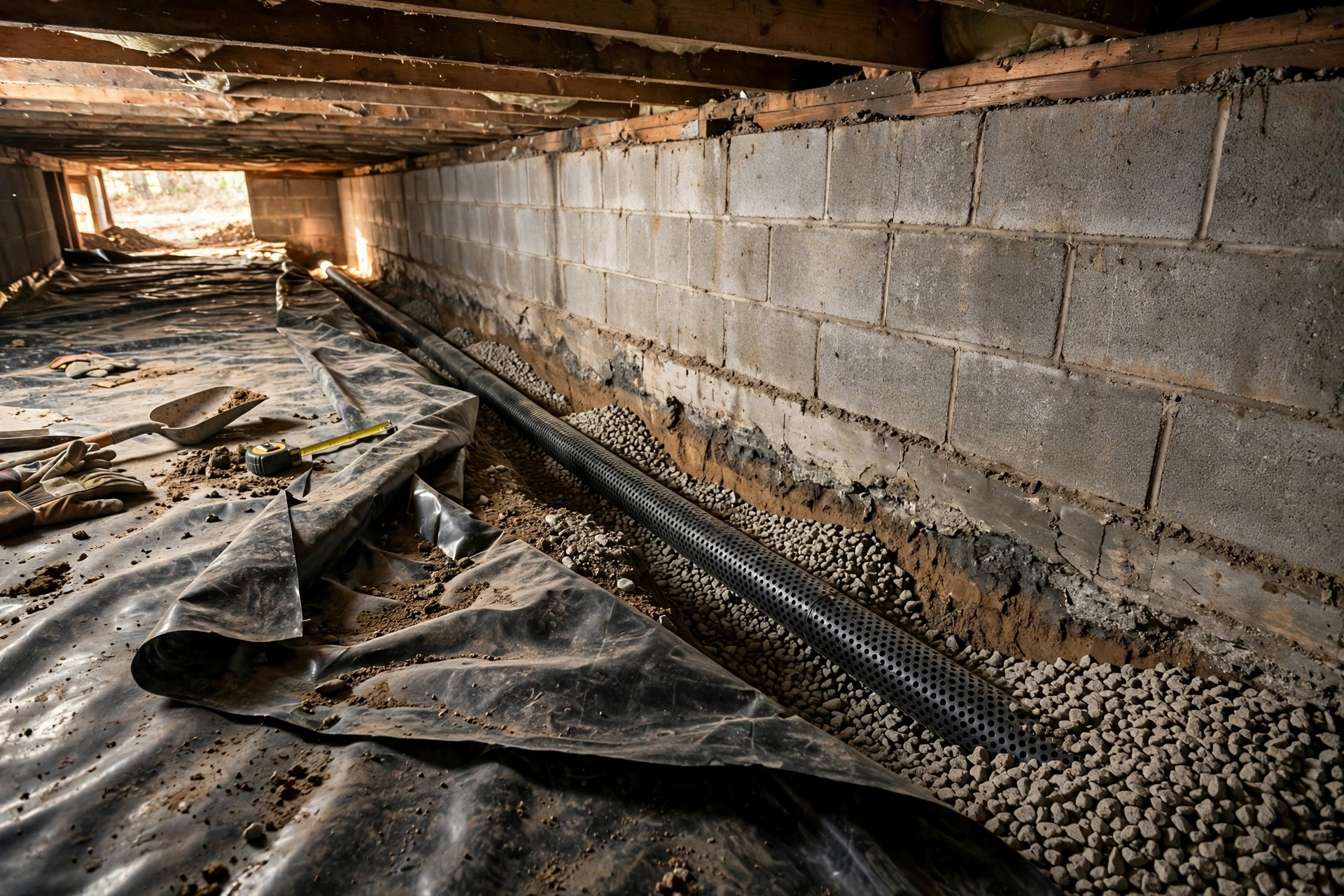
Our rule everywhere is "drainage first, then seal" — but in Greystone it's not a rule, it's physics. Sealing a crawl space while hydrostatic pressure is still pushing water through the walls just traps the water inside your new system. The barrier floats, seams stress, and you've paid for a very expensive bathtub liner. So our Greystone inspections always start outside: grading, gutter discharge points, slope direction, and where the clay is holding water against the wall. Interior French drains and sump pumps aren't upsells here — they're prerequisites, and we price them as their own line items so you see exactly what the ground demands.
Bigger homes, bigger systems
Greystone homes trend large — 3,000+ square foot footprints are common — which means more liner, longer drain runs, and dehumidifiers sized for real volume. We size everything to the actual space: liner square footage, drain capacity, and dehumidifier pints-per-day matched to the volume and the clay's moisture load.
Questions Greystone Homeowners Ask Us
What exactly is hydrostatic pressure, and why does everyone mention it in Greystone?
Hydrostatic pressure is the force of water-saturated soil pushing against your foundation. In Greystone's expansive clay on sloped lots, that force is stronger and more constant than in flatter parts of Hoover.
Think of the clay around your foundation as a sponge pressed against the wall. When it rains, the sponge swells and squeezes — water gets forced through any weakness in the wall. That's why Greystone crawl spaces can be wet even with no visible "leak": the water is being pushed through, not flowing in. Drainage relieves the pressure; encapsulation seals the space. You need both, in that order.
My lot slopes — does that make the moisture worse?
Usually, yes — on the downhill side. Sloped lots concentrate runoff against the lower foundation wall, which is exactly where hydrostatic pressure peaks.
This is the first thing we map on a Greystone inspection: which side of the house takes the water. The fix is straightforward — grading corrections, gutter extensions discharging downhill past the foundation, and interior drainage on the pressure side — but it has to be diagnosed per-lot. Two houses on the same street can have completely different water patterns.
Why is encapsulation more expensive for larger homes?
It's mostly materials and time scaling with square footage — more liner, longer drain runs, larger dehumidifier — not a premium for the neighborhood.
A 2,500 sq ft crawl space needs roughly twice the 20-mil liner of a 1,200 sq ft one, a longer French drain trench, and a higher-capacity dehumidifier. Labor scales too: more seams to seal, more wall to attach. Our quotes are itemized by component, so you can see the math — nothing is priced "because Greystone."
Can the clay actually damage my foundation, or is it just a moisture issue?
Both. The same swell-shrink cycle that drives moisture also moves foundations — it's the leading cause of foundation settlement issues in expansive-clay regions.
We're crawl space specialists, not foundation repair contractors, and we're straight about that line. What we do: relieve the water pressure driving the cycle (drainage), protect the floor framing (encapsulation), and document any foundation movement we see so you can get a structural opinion if needed. Controlling the water is the single best thing you can do for the foundation too.
What Encapsulation Costs in Greystone
Greystone systems run $6,000–$16,000 — the highest range in our service area, driven by size and soil:
| Factor | How it affects Greystone pricing |
|---|---|
| Drainage requirements | Hydrostatic pressure usually demands interior French drain + sump pump — budget this as a core component, not an add-on |
| Home footprint | Larger crawl spaces mean proportionally more liner, labor, and dehumidifier capacity |
| Grading corrections | Sloped lots sometimes need exterior grading work alongside the interior system |
A mid-size Greystone home with standard drainage needs might land $8,000–$11,000; a large footprint with significant hydrostatic pressure and grading work can reach $13,000–$16,000. See how each component is priced — the drainage line item is where Greystone differs most.
What to Expect on a Greystone Job
Greystone jobs are our most drainage-intensive work. The sequence matters: first we address water at the source — grading corrections, gutter discharge rerouting, then interior French drain and sump pump sized for the pressure we're relieving. Only when the water is managed do we seal: 20-mil floor barrier, 12-mil wall liner sealed to the walls, closed vents, and a commercial dehumidifier sized for the full volume. Rushing the seal before the drainage is done is the classic Greystone mistake, and we won't make it. Expect 4–6 days for a full system with drainage.
- Full grading and hydrostatic assessment before quoting
- Drainage installed and tested before any sealing
- Dehumidifier sized for actual crawl space volume
- Foundation movement documented with photos if observed
Greystone Encapsulation FAQs
How do I know if I have hydrostatic pressure or just a leak?
Hydrostatic pressure shows up as dampness or seepage through walls and floor joints with no single entry point — the water is being pushed through, not flowing in.
A leak has a source you can trace: a crack, a failed pipe, a grading low spot. Pressure-driven moisture is diffuse — efflorescence on walls, damp block, moisture that worsens after rain but never fully dries. Our inspection distinguishes the two, because the fixes differ.
Will a sump pump run constantly in Greystone clay?
It runs when it needs to — which in wet seasons can be regularly. That's what it's for, and we install pumps rated for the duty cycle.
We size the basin and pump for your water volume, install a battery backup (because storms knock out power), and set the float for efficient cycling. A pump that runs is a pump that's working — the alternative is that water in your crawl space.
Does encapsulation help with foundation settlement?
It addresses the cause — water cycling in expansive clay — which is the best long-term protection. But it doesn't lift a settled foundation.
If your foundation has already moved significantly, that's foundation repair territory and we'll tell you so. What encapsulation plus drainage does is stabilize the moisture conditions, which stops the cycle from continuing to move things. Prevention and stabilization, not reversal.
My crawl space is huge. Does that complicate the dehumidifier?
It means proper sizing is critical — one undersized unit in a 2,500 sq ft space will run constantly and still lose.
On the largest Greystone footprints we sometimes specify dual units or a single high-capacity commercial unit. The goal is 45–55% RH everywhere in the space, verified with readings at multiple points after install.
Get Your Free Greystone Inspection
Clay soil, sloped lots, big footprints — Greystone is the most demanding ground we work on, and it's where proper diagnosis matters most. Let's read your lot before we quote anything.
- Grading and hydrostatic pressure assessment
- Photos of wall seepage and moisture patterns
- Drainage priced as its own line — never hidden
- Honest call on foundation vs. moisture issues
Prefer to talk? (205) 208-7286