What Crawl Space Encapsulation Costs in Alabama
Real numbers, itemized. No "call for a quote" games — here's what every part of the system costs in the Hoover area, what drives the price up or down, and what we think isn't worth your money.
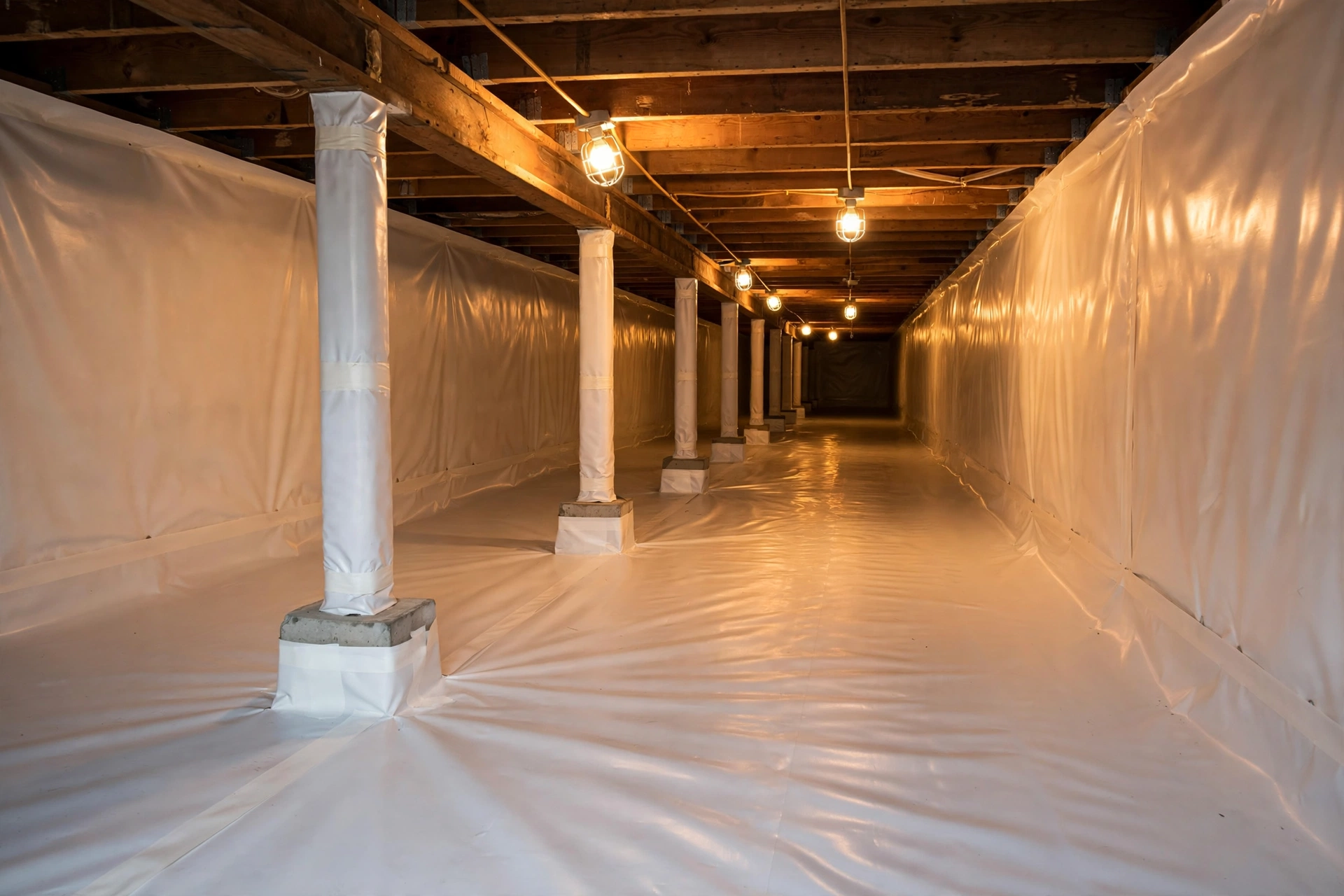
Most full encapsulation systems in the Hoover and Birmingham area cost $5,000–$15,000. A straightforward barrier-and-seal job on a clean crawl space runs $3,500–$7,000; add a dehumidifier and you're typically at $5,000–$10,000; add interior drainage and mold remediation and you're looking at $8,000–$15,000+. The midpoint for an average Hoover home in average condition is roughly $8,000–$10,000.
That range is wide because "encapsulation" isn't one product — it's a system with optional components, and your crawl space decides which ones you need. A dry 1,000 sq ft crawl space under a Bluff Park ranch needs a fraction of the work of a wet 2,200 sq ft space under a Greystone two-story with mold on the joists. Anyone quoting you a flat price over the phone without seeing the space is guessing.
Below is the full breakdown: every component, what it costs, and when you actually need it.
Full System Cost Breakdown
These are Hoover-area ranges for professional installation — materials plus labor, based on what jobs like these actually price out at around here. Labor is typically 50–70% of any line item below; crawl space work is slow, physical, and done on your belly.
| Component | Typical range | What it covers |
|---|---|---|
| Vapor barrier (20-mil floor / 12-mil walls) | $800–$2,000 | Reinforced liner, overlapped seams, sealed to walls and piers. Scales with square footage. |
| Vent sealing & air sealing | $400–$1,200 | Closing foundation vents, sealing rim-joist gaps and penetrations. Required for any sealed system. |
| Dehumidifier (commercial-grade, installed) | $1,800–$3,500 | Unit sized to the space, condensate drainage to daylight or a pump, humidistat control. |
| Interior French drain + sump pump | $3,500–$8,000 | Perimeter trench, perforated pipe, sump basin and pump. Only needed with active water intrusion. |
| Mold remediation | $1,500–$9,000 | Surface mold treatment at the low end; heavy growth with wood damage runs higher. Done before sealing. |
| Wall insulation | $1,500–$4,000 | Closed-cell foam board applied to the foundation walls in sealed systems. The energy-savings piece of the job. |
| Debris removal & old barrier disposal | $300–$900 | Clearing junk, fallen insulation, and shredded builder-grade plastic before work starts. |
| Structural repair (joists, sills, subfloor) | $1,000–$6,000+ | Only when rot or damage is found. Priced per repair after inspection — never bundled blind. |
Our quotes are itemized line by line, so you can see exactly which of these your job needs — and cross off the ones it doesn't.
Cost Per Square Foot, by Condition
Contractors who publish per-square-foot numbers are really describing condition tiers. Here's how it breaks down around Hoover:
| Condition | Per sq ft | What the job includes |
|---|---|---|
| Clean & dry | $3–$5 | Barrier, vent sealing, air sealing. No drainage, no mold, no dehumidifier beyond a basic unit. |
| Damp | $5–$8 | Everything above plus a properly sized dehumidifier and minor moisture corrections. |
| Wet or moldy | $8–$15+ | Full system: drainage, mold remediation, barrier, dehumidifier. The "do it once, do it right" tier. |
So a 1,200 sq ft crawl space that's merely damp lands around $6,000–$9,600 all-in, while the same footprint with standing water and mold can run $9,600–$18,000. The square footage matters less than what's going on down there — which is why the free inspection exists.
Why Quotes Swing From $3,000 to $15,000 for the "Same Job"
Homeowners tell us this constantly: three quotes, three wildly different numbers, all supposedly for "encapsulation." Here's what's actually different between them:
- Scope: the $3,000 quote is usually barrier-only — plastic on the ground, vents untouched, no dehumidifier. The $12,000 quote is the full sealed system. They're different jobs with the same label.
- Liner thickness: 6-mil poly sheeting costs a fraction of 20-mil reinforced barrier and lasts a fraction as long. Ask what mil — if they won't say, that's your answer.
- Drainage: quotes that include an interior French drain and sump pump run $3,500–$8,000 higher than quotes that skip it. Skipping it on a wet crawl space isn't savings; it's a future tear-out.
- Mold: some quotes remediate before sealing, some seal right over it. The cheaper one isn't cheaper — it's a mold terrarium with a warranty exclusion.
- Access: a 4-foot-tall crawl space with a proper access door installs in half the time of an 18-inch belly-crawl. Labor follows difficulty.
- What's excluded: the low quote often excludes the dehumidifier's electrical, condensate routing, debris haul-off, or the permit. Read the exclusions, not just the total.
Our advice: make every bidder quote the same written scope — barrier mil, vent sealing yes/no, dehumidifier yes/no, drainage yes/no, mold handling — and the numbers will suddenly make sense.
Hoover vs. Birmingham: Does Location Change the Price?
Not much. Labor and materials cost the same across the metro, and we price the same scope the same way in Hoover, Vestavia Hills, or Trussville. What changes is the housing stock:
Hoover leans toward subdivisions built from the 90s through the 2000s — Ross Bridge, Greystone, Trace Crossings — where the job is often replacing a degraded builder-grade membrane and adding the dehumidifier the original build skipped. Straightforward encapsulation, mid-range pricing.
Birmingham proper and older suburbs — think Forest Park, parts of Homewood — have older crawl spaces where structural repair tends to enter the picture more often: rotted sills, damaged joists, decades of deferred moisture. The encapsulation costs the same; the repair work before it adds to the ticket.
Bottom line: your crawl space's condition sets the price, not your ZIP code.
What We Won't Sell You
Part of an honest cost guide is telling you where the money is wasted. Things we don't recommend, even though we'd profit from them:
- Exterior excavation when an interior drain will do. Digging up your foundation from the outside runs $8,000–$15,000. An interior French drain solves the same water problem for $3,500–$8,000 in the vast majority of cases.
- Full encapsulation on a dry crawl space. If your space is dry with no moisture history, a quality vapor barrier and vent sealing may be all you need — at a third of the price. We'll say so.
- "Lifetime" spray-on treatments as a substitute for moisture control. Coatings don't fix humidity. We don't sell magic in a bucket.
- Oversized dehumidifiers. Bigger isn't better — an oversized unit short-cycles and wastes energy. We size to the space and the moisture load.
Paying for It: The Honest Version
We don't offer in-house financing. We'd rather tell you that plainly than bury it. Here's what Hoover homeowners actually do:
- Home equity line of credit (HELOC) — the most common route for jobs over $8,000. Rates beat credit cards by a mile, and the interest may be tax-deductible (ask your accountant, not us).
- Contractor financing through a lender — some of our customers arrange their own financing through their bank or a home-improvement lender before we start. We're happy to provide the itemized quote your lender asks for.
- Phasing the work — drainage and mold remediation now, barrier and dehumidifier next quarter. Not ideal, but honest: we'd rather phase it than watch you finance the whole thing at 24% APR.
What about homeowners insurance? Almost never covers encapsulation. Insurance covers sudden, accidental water damage — a burst pipe, storm flooding. It does not cover moisture, humidity, mold from long-term dampness, or anything an adjuster files under "maintenance." If a contractor tells you insurance will pay for your encapsulation, get it in writing from your insurer first.
Cost Questions, Answered
Is the inspection really free? What's the catch?
Yes, free — no catch, no "free with purchase." We crawl the space, take photos, and give you moisture readings and an itemized quote.
The inspection is how we earn the job. We'd rather show you exactly what's under your house than compete on vague phone quotes.
How long is your quote good for?
30 days. Material prices move, and so does our schedule — but the price we put in writing is the price for 30 days, period.
If something changes after that (say, lumber or liner pricing jumps), we'll re-quote rather than surprise you mid-job.
Will the price change once work starts?
Only if we find something genuinely hidden — and only with your approval before we touch it.
Crawl spaces hide things: a rotted sill behind insulation, an old abandoned drain line. If we find something the inspection couldn't see, we stop, photograph it, price it, and you decide. No "while we were down there" surprises on the final invoice.
Do you require a deposit?
We ask for a deposit to hold your install dates and order materials; the balance is due when the job is finished and you've walked it with us.
We don't take full payment upfront — ever. You pay the remainder after you've seen the finished system and the final moisture readings.
Will my homeowners insurance cover any of this?
Almost certainly not. Encapsulation is classified as maintenance and moisture control, which standard policies exclude.
The exception: if a covered event (burst pipe, storm damage) caused damage that requires remediation, that portion might be covered. But the encapsulation system itself — the barrier, dehumidifier, drainage as preventive work — comes out of pocket. We say this upfront so nobody plans around money that isn't coming.
Is there a cheaper time of year to do this?
Marginally. Late fall and winter are our slower months, so scheduling is easier and lead times are shorter — but we don't do seasonal discount pricing.
The real seasonal factor is urgency, not price: spring rains are when wet crawl spaces get worse. If yours takes on water, waiting for a "deal season" can turn a drainage job into a drainage-plus-mold-plus-repair job.