Crawl Space Repair in Hoover, AL
Sagging joists, rotted sill plates, damaged subfloor — structural repairs done right, before anything gets sealed up. Especially common in Bluff Park's older homes.
Here's something most encapsulation companies won't tell you: sealing a crawl space with damaged framing inside is like putting a new roof on a house with a cracked foundation. The moisture problem might be solved, but the structural problem is now hidden behind a vapor barrier where nobody can see it getting worse. We do structural crawl space repair as its own discipline — and we insist on it coming first whenever the framing demands it.
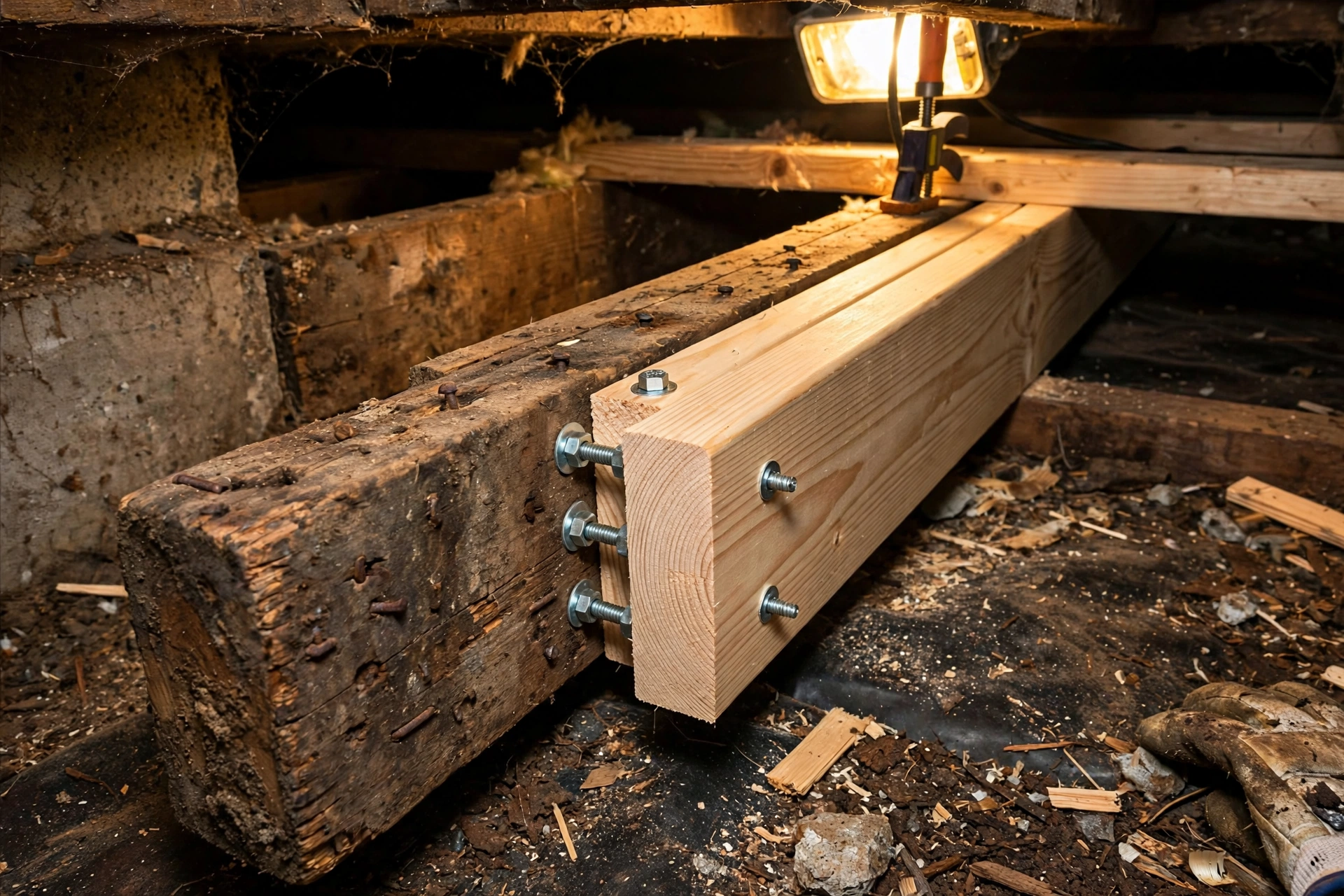
What does crawl space structural repair actually involve?
Structural repair means fixing the wood that holds your house up: sistering sagging or cracked floor joists with new lumber, replacing rotted sill plates where the framing meets the foundation, swapping out water-damaged subfloor sections, and adding support piers or beams where spans are overloaded. Every repair starts with identifying why the damage happened — usually chronic moisture — so the fix lasts.
The three repairs we see most often in Hoover:
Sistering floor joists
When a joist sags, cracks, or has lost strength to rot or insect damage, we bolt a new full-length joist alongside it — "sistering." The new joist carries the load; the old one stays as a nailer for the subfloor. This is the workhorse repair: less invasive than full replacement, structurally sound when done with proper fastening and bearing. We see this constantly in homes where a slow plumbing leak or years of humidity softened the joists over a decade.
Sill plate replacement
The sill plate is the horizontal board sitting directly on your foundation wall — the very first piece of wood in the house, and the first to rot when moisture wicks up from the masonry. Replacing sections of sill plate means temporarily supporting the load above with jacks, cutting out the rotted wood, and setting new pressure-treated lumber on a sill sealer. It's precise work, and it's the repair most often skipped by companies in a hurry.
Subfloor replacement
That soft spot near the tub or the spongy patch in front of the kitchen sink? That's subfloor damage — usually from a fixture leak that dripped into the crawl space for years. We cut out the damaged sections back to solid wood, replace with matching thickness subfloor, and re-fasten. Then we find the leak source, because new subfloor over an active drip is money thrown away.
Every crawl space we work on gets a thorough assessment first. We document moisture levels, structural condition, and drainage patterns before recommending a solution — so you get what your home actually needs, not a one-size-fits-all package.
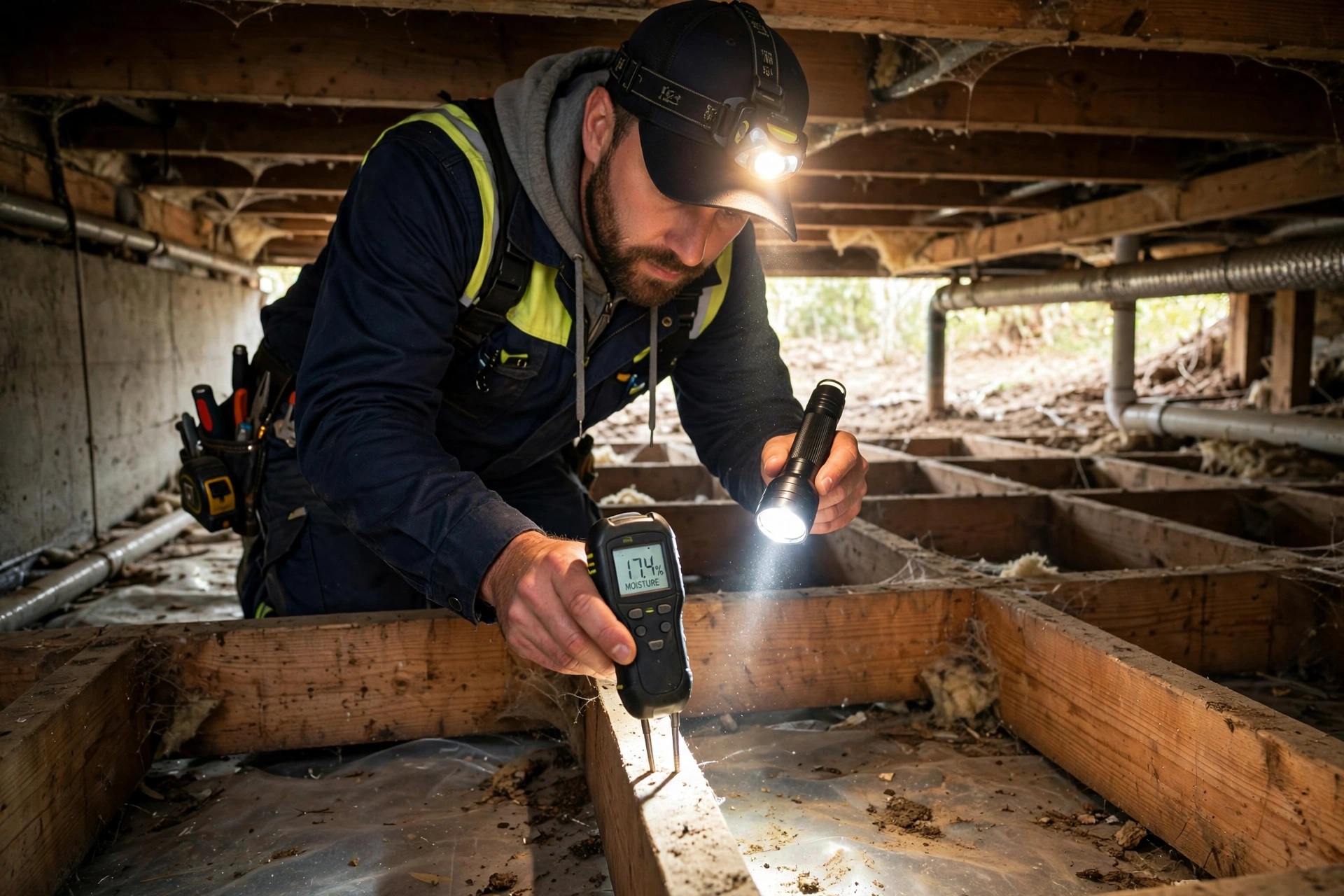
Why do Bluff Park homes need structural repair more often?
Bluff Park's housing stock — much of it built from the 1960s through the 1980s — has simply had more decades of moisture exposure than newer neighborhoods. Sixty years of humid summers, occasional plumbing leaks, and original framing add up to more sagging joists, more sill rot, and more subfloor damage than we find in 2000s-era Ross Bridge or Greystone homes.
It's not that Bluff Park homes were built poorly — they weren't. It's arithmetic. A floor joist in a 1975 Bluff Park ranch has endured roughly 50 summer humidity seasons. A joist in a 2008 Ross Bridge home has endured fewer than 20. Moisture damage is cumulative, and older homes have more of it banked.
There's a second factor: many Bluff Park crawl spaces were built with lower clearances and less ventilation than modern code expects, which traps humidity longer. And some still have the original galvanized plumbing, which means pinhole leaks that drip silently for years before anyone notices a soft floor upstairs.
None of this means an older home is a bad investment — far from it. It just means the inspection matters more, and the repair scope is honestly assessed before anyone talks about encapsulation.
Can you encapsulate over damaged framing?
Technically yes. Honestly, you shouldn't. Sealing damaged joists or rotted sills inside an encapsulated space hides the problem and lets it continue in the dark. We repair structural damage first, verify the framing is sound, and then encapsulate — in that order, every time.
Here's our rule, and it's absolute: no encapsulation over compromised structure. If our inspection finds sagging joists, rotted sills, or damaged subfloor, the quote includes the repair scope first, with encapsulation as the second phase. We'll show you photos of exactly what we found and explain why each repair is necessary.
Why are we so firm about this? Two reasons. First, a vapor barrier stapled over a rotted sill plate traps moisture against the remaining wood — potentially accelerating the decay you're trying to stop. Second, once the space is sealed and insulated, future access for structural work gets harder and more expensive. Do the bones first, then the envelope.
If another company quotes you encapsulation without mentioning the sagging joists visible in their own photos — that's a red flag, not a bargain.
What Does Crawl Space Repair Cost in Hoover?
Structural repair in the Hoover area typically runs $1,500–$8,000 depending on how much framing is affected. Here's how it breaks down:
| Repair scope | Typical range |
|---|---|
| Sistering a few joists (localized sag) | $1,500 – $3,000 |
| Sill plate section replacement | $2,000 – $4,500 |
| Subfloor section replacement | $1,500 – $3,500 |
| Multiple repairs / whole-area reframing | $5,000 – $8,000+ |
What drives it: the linear feet of damaged framing, accessibility (tight crawl spaces slow everything), whether temporary support walls are needed, and whether the moisture source (leak, drainage) also needs fixing — because repairing wood without stopping the water that rotted it is a temporary fix. When repair is combined with encapsulation, we quote both phases separately so you see exactly where every dollar goes.
Common Questions About Crawl Space Repair
How do I know if my floor joists are damaged?
From inside the house: bouncy or sagging floors, doors that stick, cracks in drywall near door frames, or soft spots. From the crawl space: visible sagging, cracking, discoloration, or softness when probed — and wood moisture readings above 20%.
Most homeowners notice the symptoms upstairs long before anyone looks underneath. A bouncy floor is the joists telling you they're deflecting more than they should. Our inspection puts eyes and a moisture meter on every joist so you're working from facts, not guesses.
Is sistering joists as good as replacing them?
For most residential repairs, yes — a properly sistered joist (full-length sister, correct fastening pattern, solid bearing on both ends) restores full structural capacity. Full replacement is reserved for cases where the original joist is too far gone to serve even as a nailer.
The key word is "properly." A short sister scabbed onto the middle of a joist with a handful of nails isn't a repair — it's decoration. We sister full-length wherever clearances allow, with engineered fastening, because the repair has to outlast the house.
Will my homeowner's insurance cover structural crawl space repair?
Usually not for gradual damage. Insurance typically covers sudden events (a burst pipe, storm damage) but excludes long-term moisture, rot, and "wear and tear" — which is what most crawl space structural damage is.
The exception: if a covered sudden event caused the damage, document everything immediately with photos and file promptly. For the slow stuff — decades of humidity, a slow drip — it's a maintenance issue, and that's exactly why catching it early with an inspection saves money.
How long does structural repair take?
Localized repairs (a few sistered joists, one subfloor section): 1–2 days. Whole-area reframing or extensive sill replacement: 3–5 days. We schedule repair as phase one, then encapsulation follows.
You can stay in the home during the work — it's all underneath. The noisiest part is the demo; the jacking and sistering is methodical rather than disruptive.
Should I fix the moisture problem or the structure first?
Both, in the right order: stop the water, fix the wood, then seal the space. Repairing joists while water still intrudes means the new wood starts rotting on day one; sealing before repairing hides damage.
That's why our quotes sequence the work: drainage/moisture source first, structural repair second, encapsulation third. Each phase protects the investment in the one before it. Any quote that skips straight to encapsulation without addressing damaged framing deserves a second opinion.
Get Your Framing Assessed
Our free inspection covers structure and moisture — photos of every joist, sill, and subfloor section we can reach, with moisture readings. You'll know exactly what your framing looks like.
- Framing photos — joists, sills, subfloor
- Wood-moisture readings throughout
- Repair scope itemized separately from encapsulation
- Honest sequencing: what comes first and why
Prefer to talk? (205) 208-7286