Crawl Space Encapsulation: Frequently Asked Questions
Straight answers to the questions Hoover homeowners actually ask us — about cost, process, warranties, and whether any of this applies to your house.
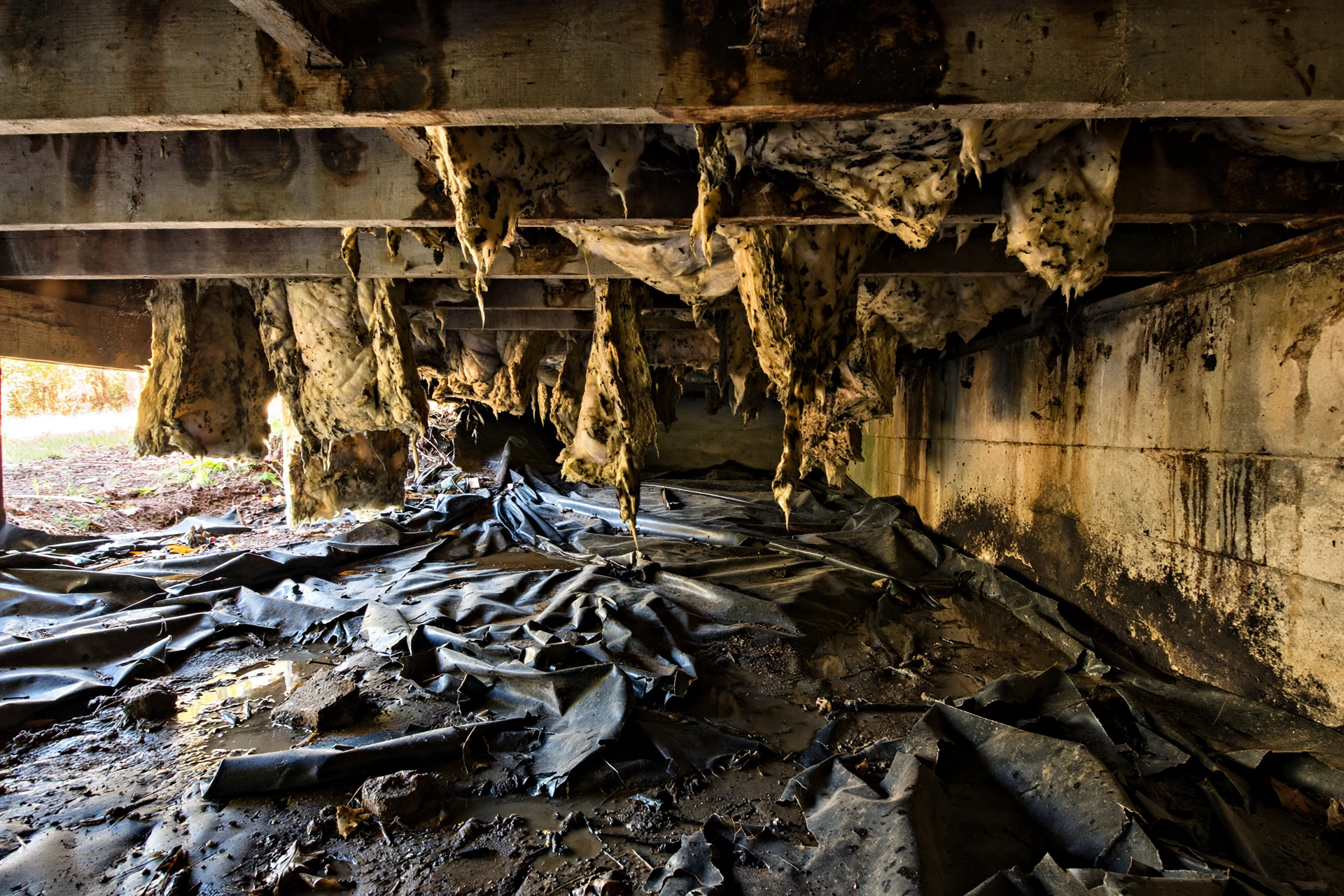
What does encapsulation cost per square foot?
Expect $3–$5 per sq ft for a clean, dry crawl space, $5–$8 for a damp one, and $8–$15+ for a wet or moldy one needing drainage and remediation.
Condition matters more than size — a small wet crawl space costs more per foot than a large dry one. See the full itemized cost breakdown →
Why did I get quotes from $3,000 to $15,000 for the "same job"?
Because they weren't the same job. The low quote is usually barrier-only; the high quote is the full sealed system with dehumidification and possibly drainage.
Liner thickness, mold handling, drainage inclusion, and what's excluded (electrical, haul-off, permits) all move the number. Ask every bidder for the same written scope — barrier mil, vent sealing, dehumidifier, drainage, mold plan — and the quotes become comparable.
What drives the price more — materials or labor?
Labor, by a wide margin — typically 50–70% of the total. Crawl space work is slow, physical, and done in tight, hot spaces.
The liner itself is a few hundred to a couple thousand dollars in material. What you're paying for is someone willing to do meticulous sealing work on their belly for days — and do it right.
How much does mold remediation add to the job?
Typically $1,500–$9,000 on top of the encapsulation, depending on how widespread the growth is and whether wood is damaged.
Light surface mold on joists is the low end. Heavy growth requiring extensive treatment and wood repair runs higher. Either way, it's done before sealing — encapsulating over mold just builds it a terrarium.
Can I install the vapor barrier myself and save money?
You can lay plastic on the ground yourself — but a DIY barrier is rarely a sealed system, and the sealing is what makes it work.
The failure points are always the details: unsealed seams, gaps around piers and penetrations, thin big-box-store poly instead of reinforced liner. If you're handy and the space is dry, a DIY 20-mil barrier is a genuine improvement. But get a professional moisture assessment first — if there's drainage or mold involved, DIY is the wrong place to save.
What thickness vapor barrier do I need in Alabama?
12-mil minimum; we use 20-mil reinforced on floors and 12-mil on walls.
Builder-grade 6-mil poly tears under foot traffic and degrades in years, not decades. For wet conditions or spaces that get serviced (HVAC, plumbing), 16–20 mil is worth it — it's the difference between a liner that lasts and one you're replacing.
Does the sump pump and drainage go in before or after sealing?
Before. Always. Drainage first, then seal — this is the most important sequencing rule in the business.
Sealing over active water intrusion gives you a lined swimming pool. The interior French drain and sump pump manage the water; the barrier and dehumidifier manage the moisture. In that order, no exceptions.
Will encapsulation interfere with my termite inspection or bond?
Not if it's done right. We leave a 3–4 inch inspection gap between the top of the wall barrier and the sill plate so termite inspectors can see the wood.
This is actually a code and industry-standard practice. Tell your pest control company the space was encapsulated — most Hoover techs see these systems weekly. The one thing to avoid: a contractor who runs the barrier all the way up with no gap. That will cause problems with your termite bond.
When is encapsulation the wrong fix — and repair the right one?
When there's structural damage. Rotted sills, compromised joists, or failing subfloor need repair before sealing — encapsulation protects wood, it doesn't fix wood that's already gone.
The right sequence is: remediate mold, repair structure, manage water, then encapsulate. A contractor who wants to seal over rotted framing is selling you a cover-up. How we handle structural repair →
How long does the job take from start to finish?
Most encapsulation jobs finish in 2–4 days. Barrier-only jobs take 1–2 days; jobs with drainage or structural repair can run a full week.
The inspection and quote come first (free), then we schedule the install — typically within 1–3 weeks depending on the season. Everything happens underneath the house, so your daily routine isn't disrupted.
What kind of warranty do you offer?
We warrant our workmanship — the installation itself — and every material carries its manufacturer's warranty (liner, dehumidifier, sump pump).
Here's what we won't do: promise a "lifetime warranty" with fine-print exclusions that void it if you look at it wrong. The exact warranty terms for your job are written into your quote before you sign anything — read them, ask questions, and hold us to them. That's the point of putting them in writing.
Will encapsulation lower my energy bills?
Yes — typically around 15% on HVAC costs, sometimes more in homes where the crawl space was very damp.
The mechanism is simple: sealed, insulated, dehumidified crawl spaces stop your system from conditioning damp air and losing energy through uninsulated floors and sweating ducts. It's not the reason to encapsulate, but it's a real payback on top of the moisture protection.
Does encapsulation help when I sell the house?
It's one of the best pre-listing improvements for homes with moisture history. A clean, dry, documented crawl space removes a major inspection flag.
Home inspectors photograph crawl spaces, and "elevated moisture / microbial growth" in a report kills deals or triggers credits. A finished system with paperwork turns that line item into a selling point. We also keep your install documentation on file if a buyer's inspector has questions later.
My home was built in the 2000s. Isn't it already protected?
Probably not anymore. Builder-grade 6-mil vapor barriers degrade in 10–15 years — if your home was built between 2000 and 2010, that plastic is likely torn, displaced, or gone.
This is the single most common surprise in Ross Bridge, Greystone, and Trace Crossings: newer homes with failed original membranes and owners who assumed they were covered. Age doesn't protect you; the membrane's condition does.
The standing water under my house dried up on its own. Problem solved?
No. Drying between rains is normal — moisture cycling is the actual problem, and it never stops on its own.
Every wet-dry cycle feeds mold, stresses wood, and moves that red clay around your foundation. The water leaving doesn't undo the damage it did while it was there, and it'll be back with the next storm. Standing water that "went away" is a drainage problem taking a break, not a drainage problem solved.
What if my crawl space sits in a high water table?
It's manageable — but it changes the design. High water table homes need a more robust drainage setup: deeper sump basin, possibly dual pumps with battery backup, and a barrier system designed to handle hydrostatic pressure from below.
This is common near the Cahaba River watershed and in low-lying parts of Hoover. It doesn't rule out encapsulation; it just means the drainage engineering matters more. We'll tell you during the inspection whether your water table is a factor — we check.
What maintenance does the system need after installation?
Less than you'd think, but not zero. The barrier is passive; the mechanicals need attention.
Plan on: checking the dehumidifier's filter and condensate drain twice a year, testing the sump pump before spring rains, and keeping gutters and grading maintained outside (the system can't overcome water you're funneling at the foundation). We'll give you a one-page maintenance sheet at completion — and if you'd rather not think about it, ask us about checkup visits.
What happens if I just do nothing?
Moisture damage compounds. What starts as damp soil becomes mold, becomes wood decay, becomes structural repair — each stage more expensive than the last.
We're not going to scare you: some dry crawl spaces can go years without intervention. But active water, visible mold, or readings over 20% don't stabilize — they progress. The honest math is that today's $4,000 drainage job beats next year's $12,000 drainage-plus-mold-plus-repair job. Get the free inspection and at least know what you're deciding about.
Will encapsulation stop mold from coming back?
Yes — if the mold was remediated first and the moisture source was fixed. Encapsulation prevents recurrence; it doesn't cure an existing infestation by itself.
Mold needs moisture to grow. A sealed, dehumidified crawl space held under 60% relative humidity is an environment where mold can't thrive. That's the whole theory, and it works — as long as nobody skipped the remediation step or sealed over standing water.
I'm buying/selling a home and the inspector flagged the crawl space. Can you help?
Yes — this is a regular part of our work. We provide written assessments with photos and moisture readings that inspectors, agents, and buyers can all work from.
For buyers: we'll tell you whether the flag is a $2,000 fix or a $15,000 problem before you're committed. For sellers: we can scope the minimum work to clear the inspection issue, or the full system if you want it as a selling point. Bring us the inspection report — we'll translate it into plain English and a real number.