Crawl Space Encapsulation in Riverchase, AL
Riverchase sits near the Cahaba River watershed, which means a higher water table and seasonal water pressure that most Hoover neighborhoods don't deal with. Encapsulation here has to account for water coming up — not just water coming in.
When the Water Comes From Below
Most crawl space moisture in Hoover comes from two directions: humid air through the vents, and runoff pushing against the foundation walls. Riverchase adds a third — the water table. The community's proximity to the Cahaba River watershed means the groundwater sits higher here than in most of Hoover, and in wet seasons it sits high enough to matter.
A high water table changes the problem fundamentally. Surface grading and gutters manage water falling on your lot. But when the water table rises after weeks of spring rain, water pushes up through the crawl space floor itself — through the soil, under the slab or liner, with no wall to defend and no gutter to reroute. Homeowners describe it accurately: "there's no leak, the water is just... there." That's the water table, and it's a Riverchase signature.
Seasonal patterns we watch for
Riverchase moisture follows the watershed's calendar. Late winter through spring — February to May — is peak season: the Cahaba system is full, the ground is saturated, and the water table is at its highest. Summer brings a different pattern: intense thunderstorms dumping inches in hours onto already-moist ground, with flash pressure against foundations. By late fall, things typically dry out. If your crawl space is worst in March and April and fine in October, that's the watershed talking, and your system needs to be designed for the March version.
1980s–2000s homes, transitional construction
Riverchase built out primarily from the 1980s through the 2000s. Earlier homes often have minimal or no vapor barrier; later ones got builder-grade 6-mil that's now aging out. Sump pumps appear in some homes but rarely with battery backup. What we typically find is a patchwork — a little plastic here, a pump there, none of it working as a system. Our job is to replace the patchwork with an actual design.
Questions Riverchase Homeowners Ask Us
There's standing water under my house after heavy rain, but it drains away. Is that normal?
Common in Riverchase, but not harmless. Water that "drains away" still spent hours against your framing and feeding mold — and every cycle deposits moisture the next dry spell can't fully remove.
The draining is actually the water table falling, not your crawl space working correctly. While it sat there, it was wicking into joists and evaporating into the air your home breathes. Encapsulation with proper drainage doesn't wait for the water to leave on its own — it intercepts it and pumps it out before it ever touches the framing.
Do I really need a sump pump, or is that overkill?
In Riverchase, a sump pump isn't overkill — it's the component the watershed demands. High water table plus seasonal pressure means water will find the lowest point, and that point should be a basin, not your crawl space floor.
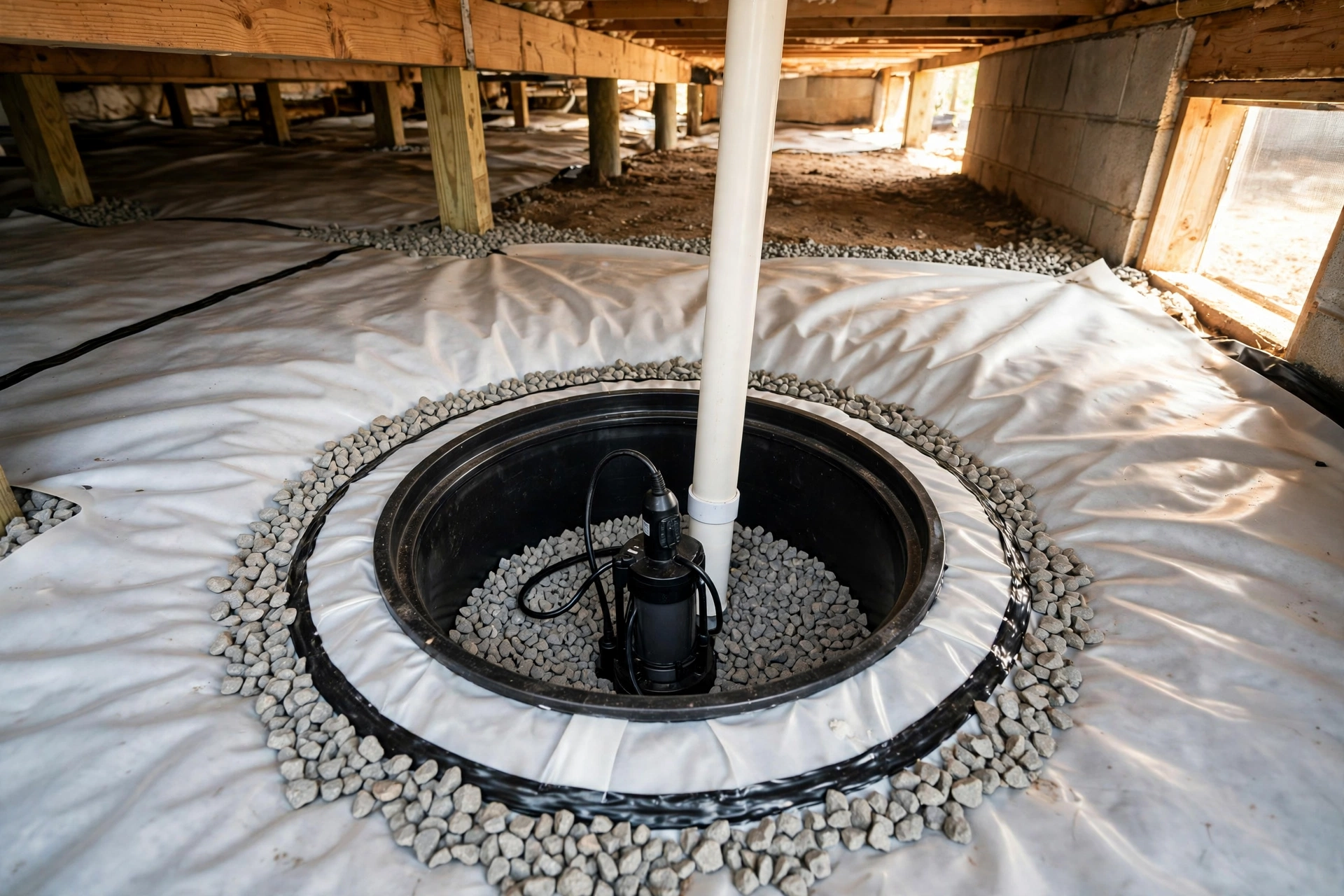
We install the pump as part of an interior drainage design: French drain channels water to the basin, the pump discharges it well away from the foundation, and a battery backup keeps it running when storms knock out power — which is exactly when you need it most. A pump without backup in Riverchase is a plan with a hole in it.
My home is near the river but not in a flood zone. Does the watershed still affect me?
Yes — flood zones map surface flooding, but the water table doesn't follow flood maps. Elevated groundwater affects homes well outside any designated floodplain.
This is the most misunderstood part of Riverchase moisture. Your home can be high, dry, and nowhere near a flood zone, while the water table underneath still rises every spring. The two are related but not the same — and the fix for groundwater pressure (interior drainage + sump) is different from the fix for surface flooding.
Will encapsulation handle the spring water table rise on its own?
No — and anyone who tells you otherwise is selling liner, not a solution. The liner seals; the drainage system handles the water. In Riverchase you need both, designed together.
Here's the failure mode: a sealed crawl space with no drainage during a water table rise becomes a sealed container filling with water. The barrier floats, seams tear, and the "encapsulation" fails in its first spring. Our Riverchase systems are always drainage-plus-seal — the pump and drain go in first, get tested, and only then do we close the envelope.
What Encapsulation Costs in Riverchase
Riverchase systems typically run $5,000–$14,000, with the water table dictating where you land:
| Factor | How it affects Riverchase pricing |
|---|---|
| Sump + drainage system | Near-mandatory here — interior French drain, sump basin, pump, and battery backup are core scope, not options |
| Water table severity | Homes closest to the watershed with documented seasonal intrusion need more drainage capacity |
| Existing patchwork | Removing failed partial fixes (old pumps, loose plastic) adds cleanout time on 1980s–90s homes |
A Riverchase home with moderate water table pressure might land $7,000–$10,000 including full drainage; one with severe seasonal intrusion and a larger footprint can reach $11,000–$14,000. Every component itemized — see the full breakdown.
What to Expect on a Riverchase Job
Riverchase jobs are drainage jobs that end in encapsulation, and the order is non-negotiable. First: interior French drain trenched around the perimeter, sump basin set at the low point, pump installed with battery backup and exterior discharge routed well away from the foundation. We test the drainage — actually run water and watch it leave — before a single sheet of liner goes down. Then the seal: 20-mil floor barrier, 12-mil walls, closed vents, commercial dehumidifier. Most Riverchase systems take 4–5 days, with drainage verification as the milestone everything else waits on.
- Water-table and seasonal pattern assessment on inspection
- Drainage installed, tested with water, then sealed over
- Battery backup on every sump pump — non-negotiable
- Discharge routed away from foundation and neighbors
Riverchase Encapsulation FAQs
What happens to the sump pump discharge? I don't want to flood my yard.
We discharge well away from your foundation — typically to daylight at the lot line or a dry well — and we plan the route so it doesn't create a problem for you or your neighbors.
Discharge routing is part of the design, not an afterthought. On sloped Riverchase lots we use gravity to our advantage; on flat lots we run solid pipe to an appropriate outlet. You'll approve the route before we install it.
How often does the battery backup actually get used?
More than you'd hope — spring storm season brings the heaviest rain and the most power outages in the same weeks. That's not coincidence; it's the design case.
A primary pump without backup is fine 360 days a year and useless on the 5 days that matter most. The backup runs on a deep-cycle battery that we test at install and that you should test yearly — we'll show you how.
Can the water table damage my foundation, or just cause moisture?
Chronic groundwater pressure erodes soil from under footings over time.
We're not foundation contractors, and we'll say so plainly. But controlling the water table's access to your crawl space is the best protection against both moisture damage and long-term soil movement. If we see foundation concerns, we document them for a structural specialist.
My crawl space is only wet in spring. Can I wait until fall for the work?
You can schedule the work for fall — but don't skip the spring inspection. We need to see the problem at its worst to design for it.
This is actually our recommended approach for seasonal Riverchase moisture: let us inspect during the wet season (photos, readings, water patterns documented), then schedule the install for drier months when the space is workable. Designing for March, building in October — that's the smart sequence.
Get Your Free Riverchase Inspection
Spring water, high water table, watershed pressure — Riverchase moisture has a specific fingerprint, and we've learned to read it. Let's find out what yours is saying.
- Water-table and seasonal pattern assessment
- Photos of intrusion points and water marks
- Drainage designed before anything is sealed
- Battery backup standard on every pump
Prefer to talk? (205) 208-7286