Crawl Space Dehumidifier Installation in Hoover, AL
Commercial-grade dehumidification sized to your square footage, with proper condensate drainage and a maintenance plan — because in Alabama, a sealed crawl space without one is a mold incubator.
Let me say the quiet part out loud: the dehumidifier is the hardest-working component in your entire encapsulation system, and it's the one most often undersized, misinstalled, or skipped entirely. A vapor barrier is passive — it sits there. A dehumidifier is active — it pulls gallons of water out of your crawl space air every single day through a Hoover summer. This page is the technical deep dive: sizing, equipment, drainage, and the maintenance that keeps it all working.
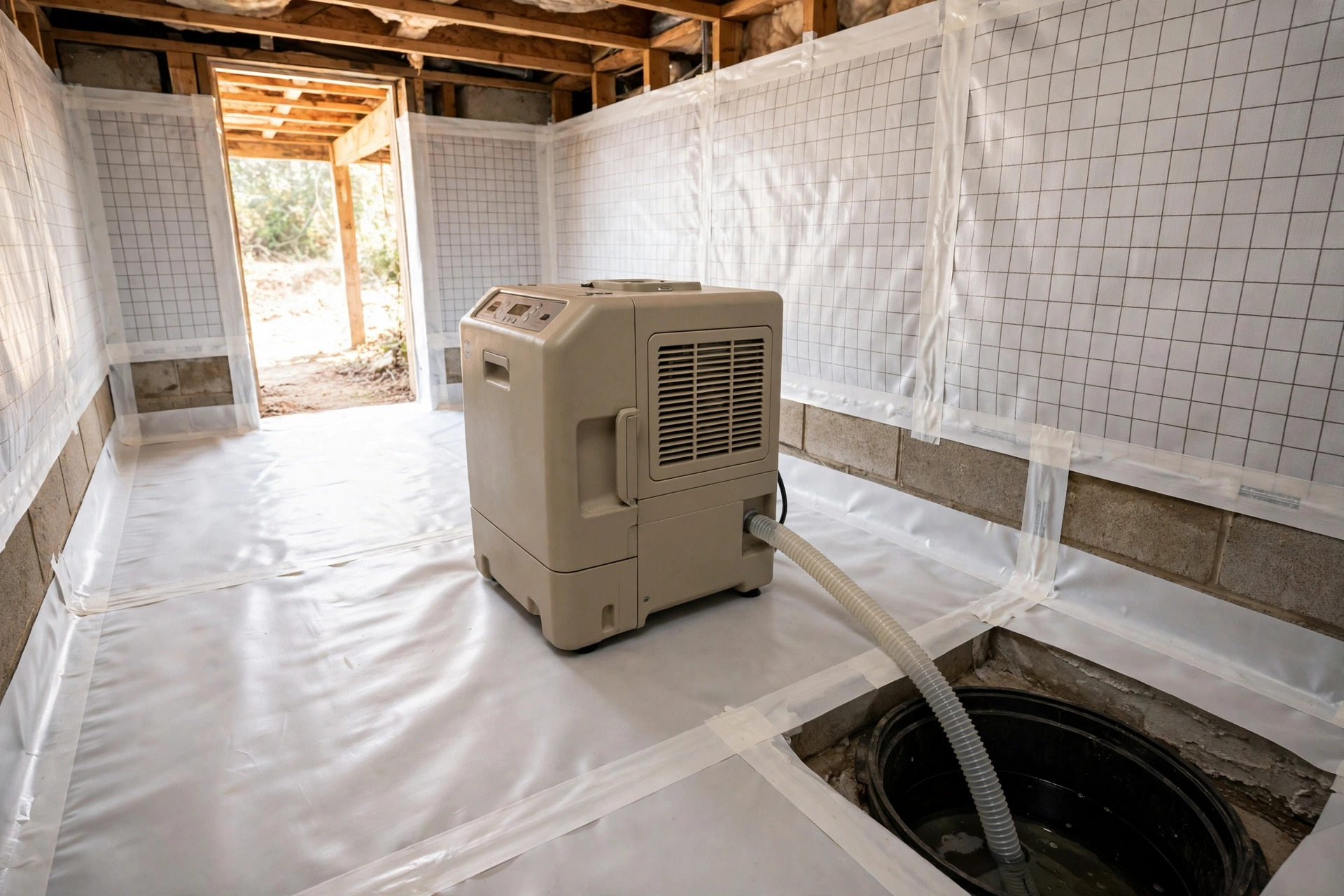
What size dehumidifier does my crawl space need?
Size by square footage and moisture load: up to ~1,200 sq ft in a sealed space typically needs a 70-pint unit; 1,200–2,000 sq ft needs 90–120 pint capacity; larger or chronically damp spaces may need 150+ pints or dual units. Oversizing slightly beats undersizing — an undersized unit runs constantly, wears out early, and still can't hold 55% RH through August.
Sizing isn't just about square footage — it's about the moisture load the unit fights:
- Square footage and volume: the baseline. A 1,000 sq ft ranch and a 2,500 sq ft two-story put very different demands on a unit. We measure the actual space, not the house's listed square footage.
- Sealed vs. vented: a sealed, encapsulated space has a dramatically lower moisture load than a vented one — which is why the dehumidifier and the sealing work as a pair. Sizing a unit for a vented space is sizing for a losing battle.
- Hoover's humidity baseline: our summers sit at 70%+ outdoor RH for months. The unit isn't maintaining a mild climate — it's fighting a constant infiltration load. We size for August, not April.
- Drainage status: if there's any history of water intrusion, the unit works harder. Drainage first (as always), then size for the controlled condition — not the emergency one.
We install commercial-grade units in the Santa Fe and AlorAir class — built for crawl spaces, not adapted from basement models. The differences that matter: higher pints-per-day-per-kWh efficiency, horizontal discharge configurations that fit low clearances, built-in humidistats with remote monitoring options, and condensate pumps rated for continuous duty. A $300 big-box dehumidifier is not the same machine, and in a sealed crawl space you'll replace it every two years while it struggles.
Every crawl space we work on gets a thorough assessment first. We document moisture levels, structural condition, and drainage patterns before recommending a solution — so you get what your home actually needs, not a one-size-fits-all package.
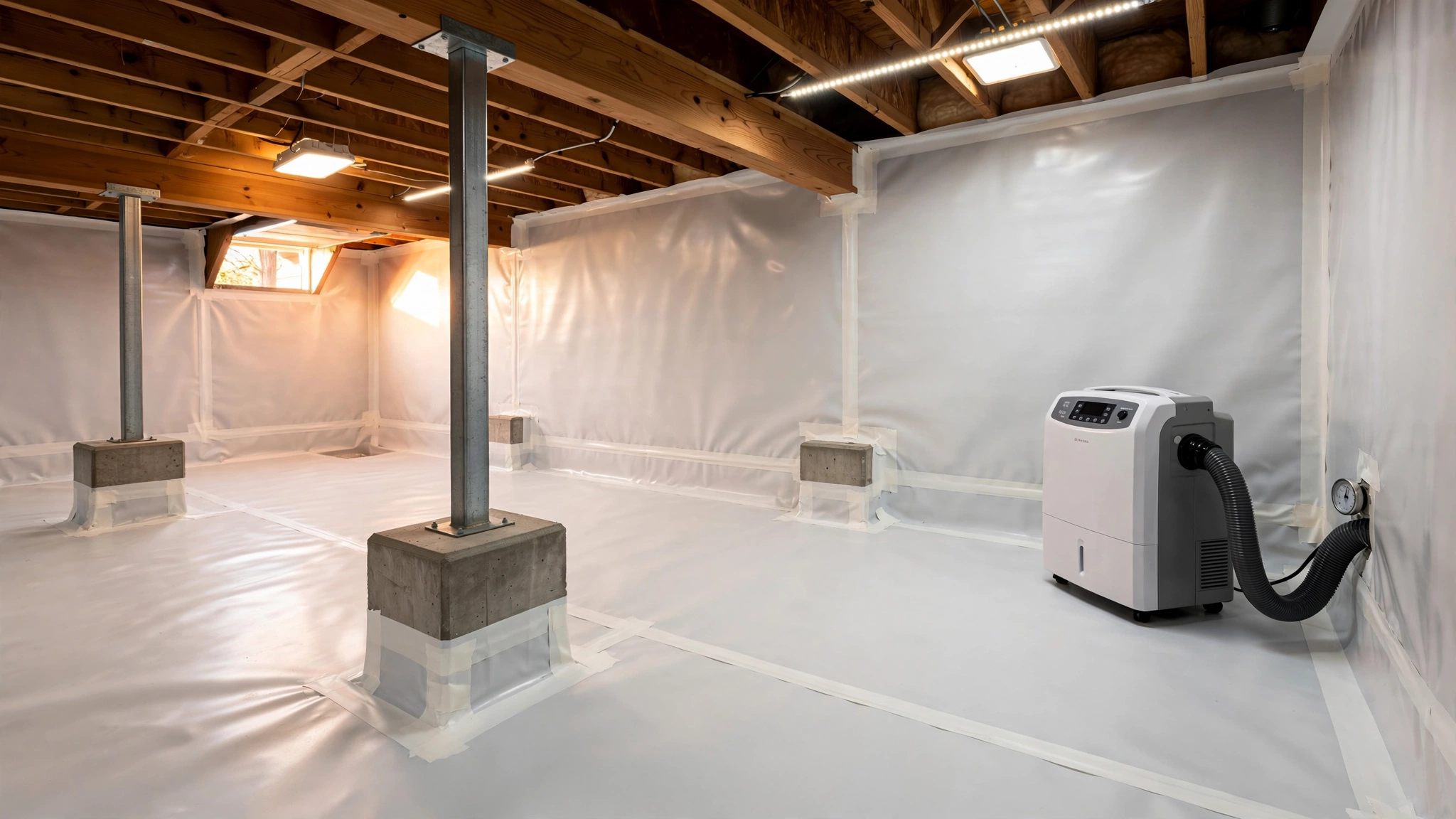
Where does all the water go?
To a drain — automatically, with no buckets to empty. We route condensate via gravity line to daylight (preferred), to a condensate pump discharging outside, or into the sump basin if a drainage system exists. The line gets a trap and an air gap where code requires it, and we verify flow before we leave.
A commercial unit in a Hoover crawl space can pull 5–15 gallons per day in peak summer. That's not a bucket you empty — that's plumbing. The three drainage options, in order of preference:
Gravity to daylight is the gold standard when the grade allows it: a condensate line pitched continuously downhill to an exterior discharge point. No moving parts, nothing to fail, silent. We use it wherever the lot slopes cooperatively.
Condensate pump handles the rest: a small pump with a float switch lifts the water through a vinyl tube to an exterior discharge. Reliable, but it's a mechanical device — we install pumps with safety overflow switches that shut the dehumidifier down if the pump fails, so a dead pump can't flood the space it's supposed to protect.
Into the sump basin when a full drainage system exists: the condensate line terminates over the basin, and the sump pump handles it with everything else. Clean, simple, one fewer device to maintain.
What we never do: drain condensate onto the vapor barrier, into a random low spot, or into a bucket "for now." Every gallon has a designed path out of the house.
What maintenance does a crawl space dehumidifier actually need?
Less than you'd think, more than zero: clean or replace the air filter every 3–6 months, verify condensate flow twice a year, and have the coils and humidistat checked annually. Total annual effort: about an hour. Total cost of neglect: a $2,500 unit dying years early while mold returns.
The maintenance schedule we give every customer:
- Every 3–6 months: filter check. Slide it out, hold it to the light — if you can't see through it, clean or replace it. A clogged filter makes the unit work harder, run longer, and dehumidify less. In dusty crawl spaces (post-construction, near unpaved areas), check quarterly.
- Twice a year (spring and fall): condensate verification. Pour a cup of water into the drain line access or confirm the pump cycles. Check the discharge point outside — make sure it's not buried, frozen, or blocked by landscaping.
- Annually: coil inspection and humidistat calibration. Dust on coils reduces efficiency; a drifting humidistat means the unit thinks it's at 50% when it's really at 65%. We offer this as a service visit, or we'll walk you through the DIY version.
Most of our units now come with remote monitoring options — a sensor that alerts your phone if humidity spikes or the unit faults. For a rental property or a home you're away from often, it's cheap insurance on a system you can't see.
What happens if I encapsulate without a dehumidifier?
You get a sealed, humid box. The barrier blocks ground vapor, but moisture still enters through the slab edge, the foundation walls, and every penetration — with vents sealed, there's now no airflow to carry it out. Relative humidity climbs, condensation forms on the coolest surfaces (ducts, pipes), and mold grows on the joists you just paid to protect.
We've been called into homes where another company installed a beautiful barrier — 20-mil, taped seams, wrapped piers — with no dehumidification. Within two summers, the humidity inside the sealed space was higher than before the work, because the sealing trapped moisture that used to ventilate out. The barrier was perfect. The system was broken.
In drier climates, passive encapsulation can work. Hoover is not a drier climate. Our position is simple: we don't sell encapsulation without dehumidification in this market. If a quote you received skips it to hit a lower price, that quote isn't cheaper — it's incomplete.
What Does Dehumidifier Installation Cost in Hoover?
Professional dehumidifier installation in a Hoover crawl space typically runs $1,800–$3,500:
| Installation scope | Typical range |
|---|---|
| 70-pint commercial unit, gravity drain, smaller home | $1,800 – $2,400 |
| 90–120 pint unit, condensate pump, average home | $2,400 – $3,000 |
| Large home / dual units / remote monitoring | $3,000 – $3,500+ |
What drives it: unit capacity (bigger costs more), drainage complexity (gravity is cheapest; condensate pump adds parts and labor), electrical (a dedicated circuit if the panel is far or full), and accessibility. As part of a full encapsulation package, the dehumidifier is itemized separately — you'll see exactly what it costs versus the barrier, the insulation, and the drainage.
Common Questions About Crawl Space Dehumidifiers
What humidity level should a crawl space dehumidifier maintain?
45–55% relative humidity is the target. Below 60% stops mold growth; below 50% is ideal for wood preservation. Above 60% sustained, you're back in mold territory regardless of what else was installed.
We set the humidistat to 50% and verify with independent sensors — not just the unit's onboard reading, which can drift. If your crawl space has a monitor showing 68% after "encapsulation," the system isn't working, whatever the invoice said.
How much electricity does a crawl space dehumidifier use?
A commercial 90-pint unit draws roughly 500–700 watts while running — comparable to a few old incandescent bulbs. In a sealed Hoover crawl space, expect $15–$30/month in electricity during peak summer, less in winter.
Context matters: the ~15% HVAC savings from a sealed, conditioned crawl space typically outweighs the dehumidifier's draw several times over. And an efficient commercial unit uses far less than an undersized residential unit running 24/7 and failing anyway.
Can I just use a regular basement dehumidifier from the hardware store?
It'll run, but it won't last and won't keep up. Residential units aren't built for continuous duty in 90°F+ crawl space heat, their condensate handling assumes you'll empty a bucket, and most can't hold 50% RH against Hoover's summer moisture load.
We replace failed big-box units regularly — usually after 1–2 years of constant running, often with the homeowner frustrated that "dehumidification doesn't work." It works fine; the equipment was wrong for the job. Commercial crawl space units are engineered for exactly this environment.
Do I need to winterize the dehumidifier?
In Hoover, generally no — our winters are mild enough that the unit runs year-round, just less often. Keep it powered and the filter clean; it'll cycle as needed.
The one winter concern: condensate discharge lines exposed to freezing. We route and insulate exterior discharge to prevent freeze blockage, and condensate pumps with overflow safety switches protect against the rare hard freeze. If you're leaving town for an extended winter trip, leave the unit running — a $20 electric bill beats coming home to a humidity spike.
How long do commercial crawl space dehumidifiers last?
10–15 years with filter maintenance and annual checkups. Units that run oversized-short-cycle or with chronically clogged filters die younger; properly sized units in sealed spaces hit the long end of that range.
When replacement time comes, it's a swap — the drainage, electrical, and ducting (if any) are already in place, so replacement costs roughly half of the original install. Budget for it around year 12 and it won't surprise you.
Size It Right, Install It Once
Our free inspection measures your space, checks your humidity, and specs the right unit — with condensate drainage designed, not improvised. No undersized hardware store units, no skipped drainage.
- Humidity readings from your actual crawl space
- Unit sized for August, not April
- Condensate drainage with a designed path out
- Maintenance schedule you'll actually follow
Prefer to talk? (205) 208-7286