Crawl Space Encapsulation in Ross Bridge, AL
Ross Bridge homes were built in the 2000s–2010s with builder-grade 6-mil vapor barriers — and those barriers are hitting their 10–15 year expiration right now. Your home can be beautiful, well-kept, and still have a failing crawl space. Here's why, and what we do about it.
The "My House Is New" Myth
Ross Bridge is Hoover's showcase community — golf course, resort, gorgeous homes built mostly between 2000 and 2015. When we tell a Ross Bridge homeowner their crawl space needs attention, the first reaction is almost always disbelief. "But my house is only fifteen years old." We understand the reaction. The house looks perfect. The problem is invisible, and it's on a timer the builder set.
Here's that timer: production builders in the 2000s installed 6-mil polyethylene as the vapor barrier — the thinnest, cheapest option that met code. Unsealed seams, no wall attachment, laid loose on the ground. That plastic has a functional lifespan of roughly 10–15 years before it tears, displaces, and degrades. For a home built in 2008, the barrier has been failing since around 2020. The homeowner never noticed, because nobody looks under the house until something forces the issue.
What we actually find
Torn sheets bunched in corners. Barrier pulled back from the walls, exposing bare earth. Sections where irrigation or grading runoff got underneath and the plastic is floating. And beneath all of it, framing that's been absorbing ground moisture for years — often with the first generation of mold growth establishing on joists. The homes are young enough that structural damage is rare. But the moisture problem is real, current, and getting worse every summer.
Golf-course-community drainage
Ross Bridge's terrain creates a drainage pattern we don't see elsewhere in Hoover. The community is built around a golf course on rolling land, which means many homes sit below irrigated fairways or at the bottom of landscaped slopes. Irrigation runs daily in summer — thousands of gallons soaking ground uphill of your foundation. Add Hoover's clay soil, which sheds water laterally instead of absorbing it, and you get hydrostatic pressure against foundation walls that has nothing to do with rainfall. We map irrigation and grading runoff on every Ross Bridge inspection, because it's frequently the primary water source.
Questions Ross Bridge Homeowners Ask Us
My home passed inspection when I bought it — how can the crawl space be bad?
Home inspectors check for active problems at a point in time. A degrading vapor barrier is a slow failure — it looks "present" long after it stops working.
An inspector in 2019 sees plastic on the ground and checks the box. But torn, displaced, unsealed 6-mil isn't functioning as a barrier — it's landscaping fabric with ambition. The failure is gradual and invisible from the access point. Our inspections go further: we pull moisture readings across the framing and photograph the barrier's actual condition, not just its presence.
Does my HOA restrict crawl space work?
Almost never — encapsulation is entirely under the house and invisible from the street. No exterior changes, no HOA approval needed in our experience.
The only occasional consideration is exterior grading or drainage work if we recommend it, which can touch visible landscaping. We flag that upfront and keep any exterior work minimal and tidy. The encapsulation itself? Your HOA will never know it happened — except your home stops smelling musty.
Can't I just have the builder's barrier replaced with a thicker one?
You could, but you'd be repeating the original mistake. A thicker loose-laid sheet still has unsealed seams and no wall attachment — it's a better bandage on the same wound.
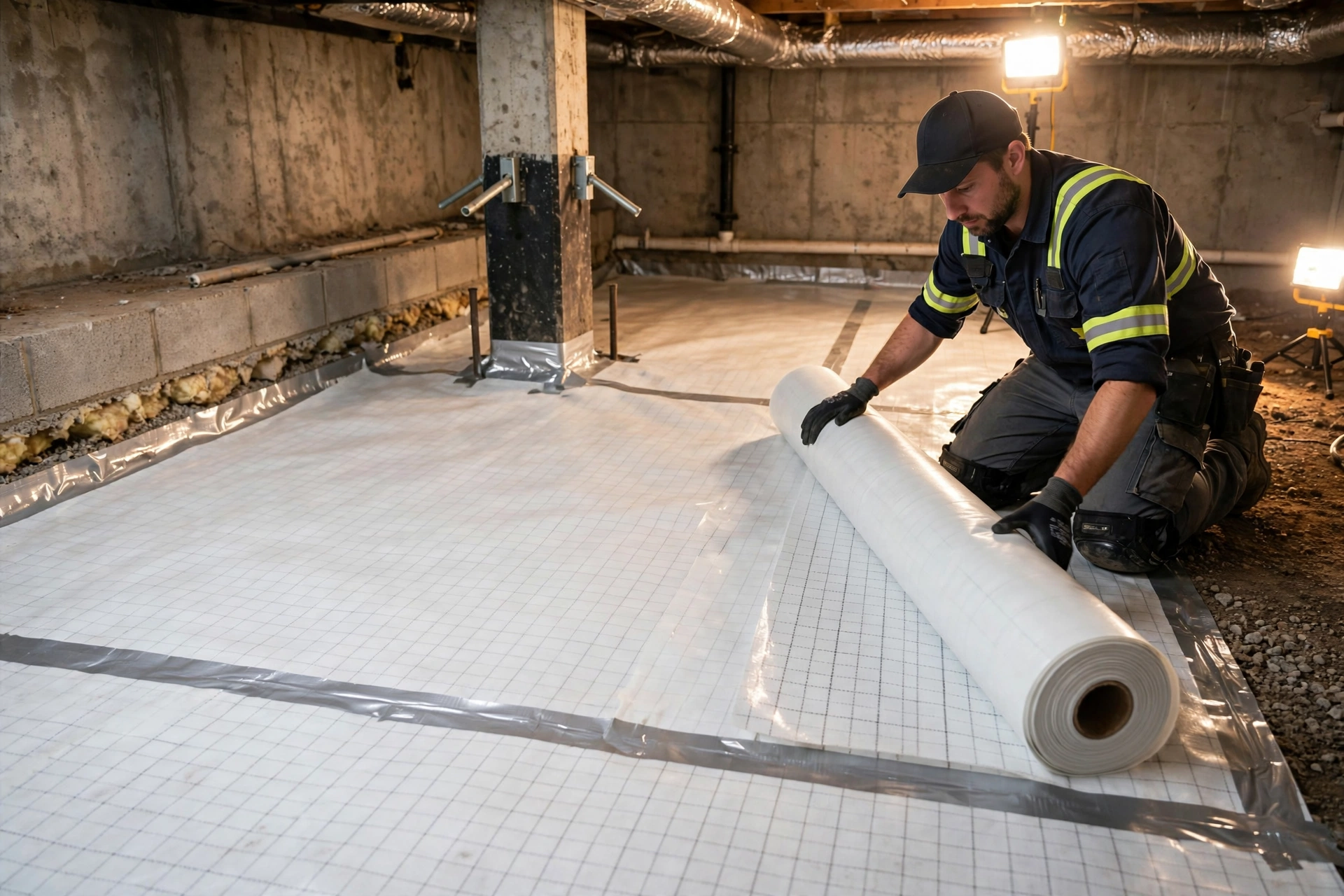
What makes encapsulation different isn't just mil thickness (though we use 20-mil reinforced on floors). It's the system: sealed seams, wall attachment, closed vents, and dehumidification. Replacing the barrier alone leaves Alabama's humid air free to condense on your framing. That's the part the builder never addressed.
The golf course irrigates right behind my house. Is that causing my moisture problem?
Often, yes — it's one of the most common water sources we trace in Ross Bridge. Daily irrigation uphill of a clay-soil foundation is a slow, constant hydrostatic load.
Clay doesn't absorb that water; it moves it sideways, straight to your foundation wall. This is why our Ross Bridge inspections always include a grading and runoff assessment. Sometimes the fix includes exterior drainage improvements alongside the encapsulation — we'll show you exactly where the water is coming from before recommending anything.
What Encapsulation Costs in Ross Bridge
Ross Bridge systems typically run $5,000–$14,000. Newer homes have advantages (sound framing, good access) and one wild card:
| Factor | How it affects Ross Bridge pricing |
|---|---|
| Barrier replacement scope | Full removal of failed builder barrier plus new system — cleanout is straightforward since debris is minimal |
| Drainage assessment | Irrigation/grading-driven water may require exterior drainage work — the main variable on golf-course lots |
| Home size | Ross Bridge homes trend larger; more square footage means more liner, more labor, bigger dehumidifier |
A straightforward 1,500 sq ft encapsulation with no drainage issues might land $6,000–$8,000; add exterior drainage for irrigation runoff and a larger footprint and you're looking at $10,000–$14,000. See the itemized breakdown of every component.
What to Expect on a Ross Bridge Job
Ross Bridge jobs are cleaner than average — less debris, sound framing, good access — which means we move fast once the plan is set. Day one: remove the failed builder barrier, inspect and treat any early mold, assess grading and irrigation runoff. Then the full system: sealed vents, 20-mil floor barrier with sealed seams and wall attachment, 12-mil wall liner, commercial dehumidifier with condensate drainage. If the runoff assessment calls for exterior drainage improvements, we handle that as a separate, itemized phase. Most Ross Bridge encapsulations finish in 2–4 days.
- Complete removal of the failed builder-grade barrier
- Irrigation and grading runoff assessment included
- Full sealed system — not just a thicker loose sheet
- Exterior drainage options itemized separately, never bundled silently
Ross Bridge Encapsulation FAQs
How do I know if my builder's vapor barrier has failed?
You almost certainly can't tell from the access point — that's why we photograph it. The signs are torn sections, displaced sheets, standing water on top of the plastic, and elevated wood-moisture readings.
If your home was built between 2000 and 2012 and the barrier has never been touched, assume it's compromised until proven otherwise. Our free inspection gives you the photographic proof either way.
Will encapsulation affect my home's resale value in Ross Bridge?
It removes one of the most common inspection flags in this price range — moisture and mold in the crawl space kill deals or trigger credits.
Ross Bridge buyers pay for peace of mind. A documented encapsulation with moisture readings and warranty paperwork turns the crawl space from a negotiation liability into a selling point. Several of our jobs here were motivated by pre-listing inspections.
My crawl space is tall and easy to access. Does that lower the cost?
Yes — good access is one of the few things that genuinely reduces labor cost. Our crews move faster and the work is more thorough.
Ross Bridge homes often have 3+ feet of clearance, which is a luxury compared to older Birmingham bungalows. You'll see that reflected in the labor line of your itemized quote.
Do you work around the golf course schedule or community rules?
We keep our footprint tight: materials staged discreetly, work vehicles parked considerately, and exterior work (if any) restored to match.
All encapsulation work is under the house, so the visible impact is minimal — a work vehicle in the driveway for a few days. If your street has specific contractor-hour rules, tell us upfront and we'll schedule around them.
Get Your Free Ross Bridge Inspection
Fifteen years is the expiration date on your builder's barrier — not a suggestion. Let's find out where yours stands before the next humid summer does more of the talking.
- Photos of your barrier's real condition
- Moisture readings across all framing
- Irrigation and grading runoff assessment
- Itemized quote — no bundled surprises
Prefer to talk? (205) 208-7286