Crawl Space Waterproofing in Hoover, AL
Our rule is simple: drainage first, then seal. Interior French drains, sump pumps, and grading that handle Hoover's clay soil — before a single square foot of barrier goes down.
Waterproofing and encapsulation get confused constantly, so let's draw the line clearly. Waterproofing manages water. Encapsulation manages moisture. Water is the puddle after a storm, the seepage through the foundation wall, the spring that appears every March. Moisture is the humidity in the air, the vapor rising from the soil, the condensation on your ducts. You can have one without the other — and the fixes are different. This page is about water: where it comes from, how we move it away from your house, and why this work has to happen before anything gets sealed.
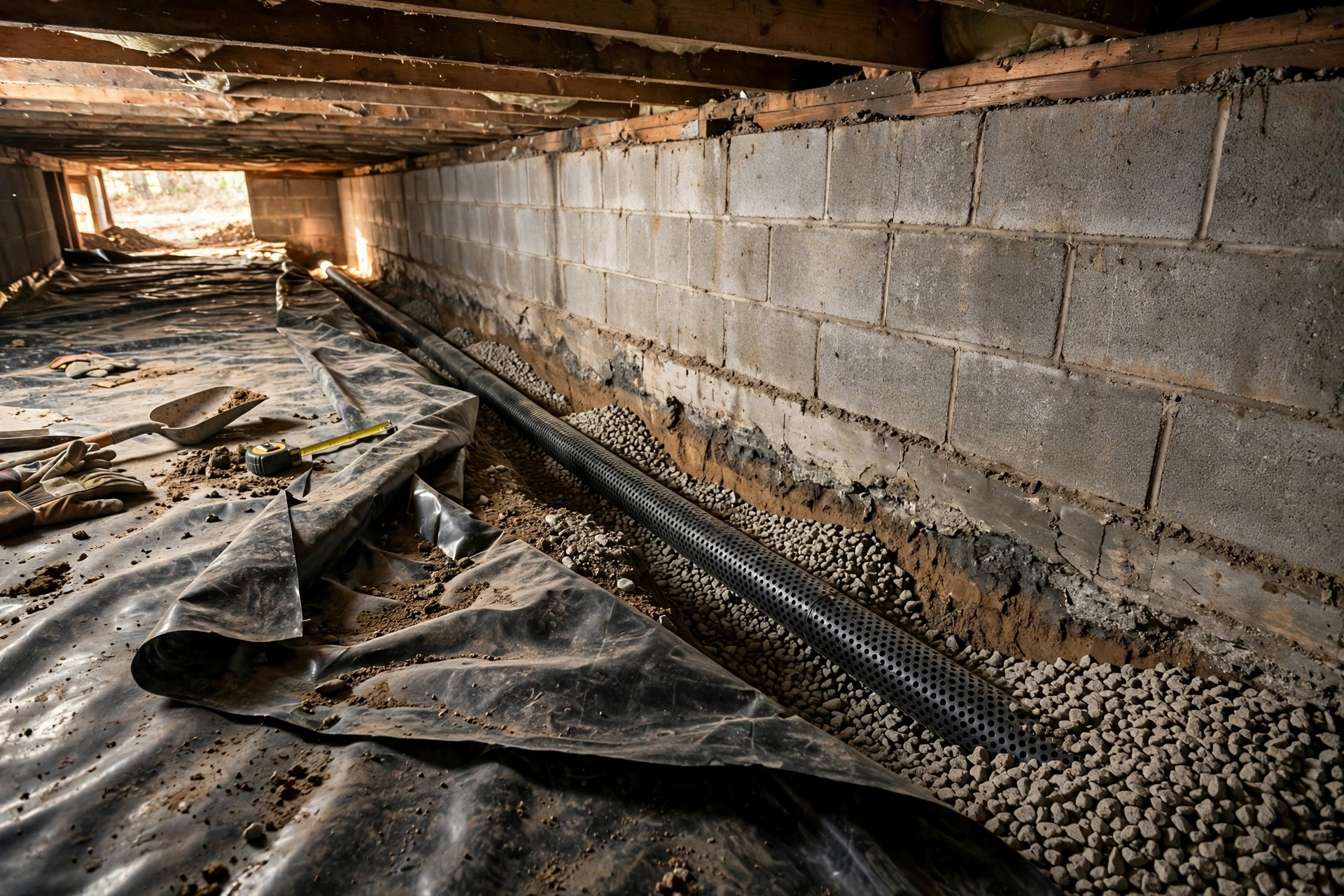
What does "drainage first, then seal" actually mean?
It means no vapor barrier, no sealed vents, and no insulation go in until active water intrusion is controlled. An interior French drain collects water at the foundation footing and routes it to a sump basin; the pump discharges it away from the house. Only when the space stays dry through rain events do we seal the envelope — because sealing over water just hides it.
We lead with this because it's the most common corner we see cut in our market. A barrier laid over a crawl space that takes on water every spring will float, tear at the fasteners, and trap water under the plastic — where it sits against your floor framing in the dark. The homeowner thinks the problem is solved because the ground looks covered. The joists disagree.
Our sequence on any wet site:
Find the water's path
During or right after rain is ideal. We trace where water enters — through the wall-floor joint, up through the soil, down a slope — and map it. Different entry points get different fixes.
Install interior drainage
A perforated pipe in washed stone runs along the interior footing, pitched to a sump basin. Water that would have pooled on the soil now has a channel to follow.
Set the sump and discharge
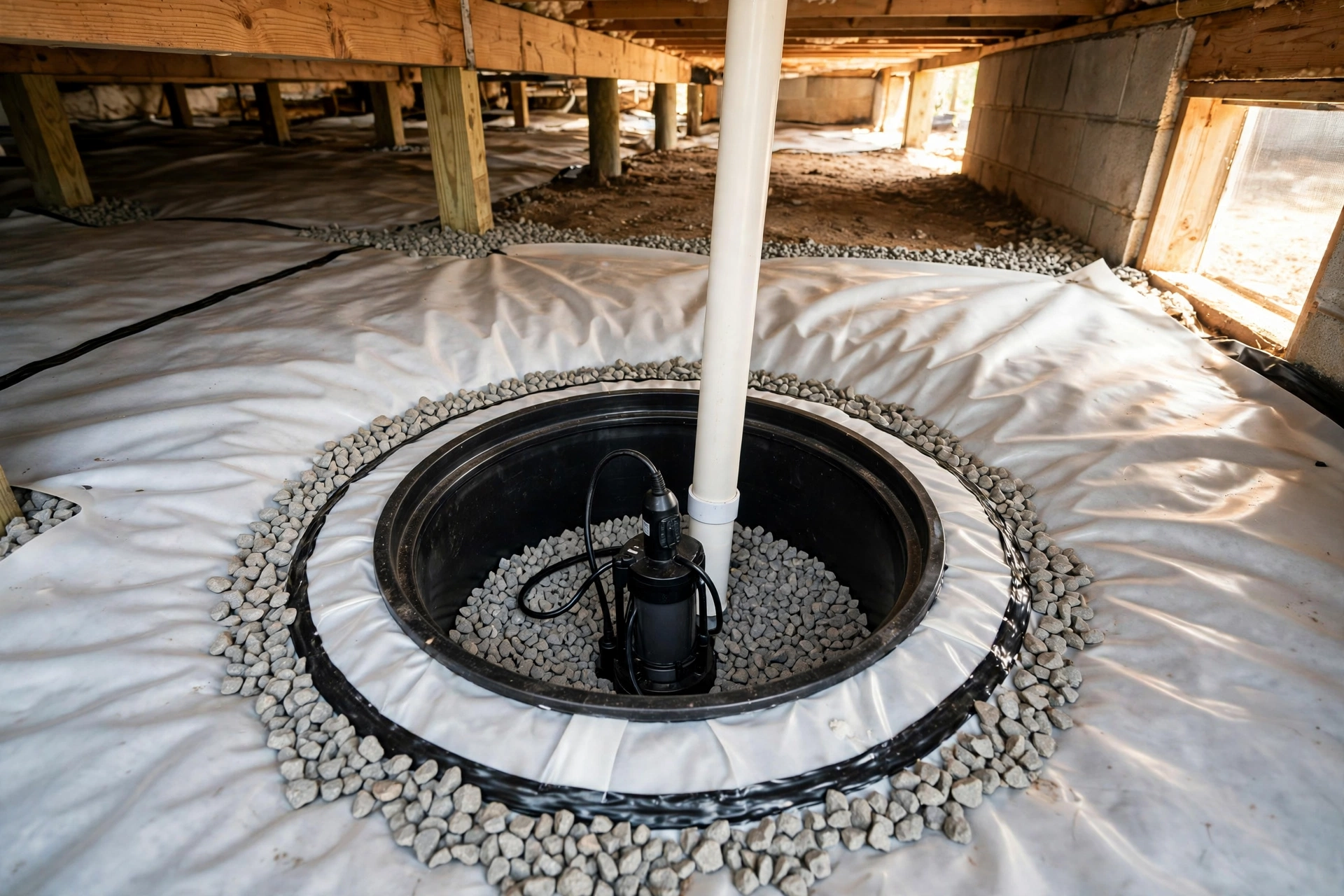
Basin, primary pump, and discharge line routed well away from the foundation — not dumped at the corner to run right back. Battery backup if the site warrants it.
Verify through weather
We want to see the system handle real rain before we seal over it. A dry crawl space after a storm is the green light for encapsulation.
Every crawl space we work on gets a thorough assessment first. We document moisture levels, structural condition, and drainage patterns before recommending a solution — so you get what your home actually needs, not a one-size-fits-all package.
Interior vs. exterior waterproofing — which do I need?
For most Hoover homes, interior drainage is the right answer: it's less invasive, costs a fraction of exterior excavation, and handles the water table and wall-floor seepage that cause most crawl space water problems. Exterior waterproofing (excavating to the footing, membrane, exterior drain) is reserved for severe cases — structural wall issues or sites where interior access is impossible.
Here's the honest comparison:
- Interior French drain + sump: installed from inside the crawl space, no excavation of your yard, typically $4,500–$8,000. Manages water that reaches the interior footing — which is where Hoover's clay-soil water pressure shows up. This solves the problem for the large majority of wet crawl spaces we see.
- Exterior waterproofing: excavate around the foundation to the footing, apply membrane, install exterior drain tile, backfill. Effective but disruptive and expensive — often $8,000–$15,000+ — and it doesn't address humidity at all. We recommend it only when interior drainage can't solve the problem: failing foundation walls, extreme grading constraints, or no crawl space access.
- Grading and gutters: the unglamorous first step. If your yard slopes toward the house or your downspouts dump at the foundation, fix that before anything else. We've seen "waterproofing problems" solved with $800 of grading and downspout extensions. We'll tell you if that's your situation.
Be wary of any company that leads with exterior excavation for a standard wet crawl space. It's the most expensive option, and it's rarely the necessary one.
When is waterproofing enough without full encapsulation?
Waterproofing alone is enough when your problem is water but not humidity: seasonal puddling with no mold, no musty odor, and wood moisture that drops back under 18% once the water is gone. If you also have mold, condensation, or persistent musty air, you need the full system — drainage plus encapsulation.
This is a judgment call we make with the moisture meter, not a sales script. After drainage is installed and the space has been through a few rain cycles, we re-check: wood moisture readings, humidity levels, any odor. If the numbers are clean and stay clean, encapsulation would be spending money to solve a problem you no longer have — and we'll say so.
But here's the pattern we see most in Hoover: the water was the visible problem, and the humidity was the bigger problem hiding behind it. Homes near the Cahaba River watershed and in low-lying parts of Riverchase often have both — seasonal intrusion and year-round humidity above 70%. In those cases, drainage is phase one and encapsulation is phase two, and doing only phase one leaves half the problem in place.
Our inspections are sequenced for exactly this: fix the water, measure what remains, then recommend — not the other way around.
What Does Crawl Space Waterproofing Cost in Hoover?
For a full interior drainage installation around a Hoover home, expect $4,500–$8,000. Here's how that breaks down:
| Waterproofing scope | Typical range |
|---|---|
| Sump pump + basin only (localized water) | $1,800 – $3,000 |
| Interior French drain + sump pump (full perimeter) | $4,500 – $8,000 |
| Adding battery backup to the sump | $800 – $1,500 |
| Regrading / extending downspouts | $800 – $2,500 |
What drives it: linear feet of drain, number of sump basins (large or L-shaped footprints may need two), discharge distance, and whether battery backup is warranted — if your power tends to go out during the same storms that flood the crawl space, the backup isn't optional. Exterior excavation, when truly needed, starts around $8,000 and climbs with depth and access difficulty.
Common Questions About Crawl Space Waterproofing
Why does my crawl space flood every spring?
Spring combines the two things Hoover's clay soil handles worst: heavy rainfall and a rising water table. The clay swells, hydrostatic pressure builds against your foundation, and water finds the wall-floor joint — the weakest point.
It's worse in low-lying areas and near the Cahaba watershed. The pattern is predictable, which means the fix is predictable too: intercept the water at the footing with interior drainage before it pools. Homes that flood "every spring" stop flooding once the drain is in — it's one of the most reliable fixes we do.
Will a sump pump keep my crawl space dry by itself?
A sump pump alone handles water that reaches the basin — but without a French drain feeding it, water pools elsewhere first. The drain is the collection system; the pump is just the exit. You need both for a dry space.
Think of it this way: a sump basin without perimeter drainage is a bucket in the middle of a wet floor. It'll pump what flows to it, but water takes the path of least resistance — which is usually around the basin, not into it. The drain gives every drop a channel to the pump.
How long do sump pumps last?
A quality primary sump pump lasts 7–10 years with normal cycling. Pumps in high-water sites that run constantly may last 5–7. Battery backups need new batteries every 3–5 years.
We install pumps with vertical float switches (fewer hang-ups than tethered floats) and we show you how to test the system — pour a bucket of water in the basin twice a year and confirm it pumps. A $400 pump protecting a $10,000 encapsulation deserves 30 seconds of attention twice a year.
Can waterproofing be done from outside without digging up my yard?
Surface-level exterior work — regrading, downspout extensions, French drains in the yard — can be done without major excavation and often helps. But true exterior foundation waterproofing requires digging to the footing; there's no way around that.
That's exactly why we lead with interior drainage: same result for most water problems, no torn-up yard, roughly half the cost. Start with grading and gutters (cheap, often surprisingly effective), then interior drainage for what remains.
Do I need a battery backup for my sump pump?
If your power goes out during heavy storms — the exact moments your pump is needed most — yes. A battery backup keeps the pump running through outages, typically for 6–12 hours of intermittent pumping.
Hoover's spring storm season brings the kind of weather that knocks out power and dumps inches of rain in the same night. A sump pump without backup in that scenario is a pump that quits when you need it most. We'll assess your outage history and water volume honestly — not every site needs it, but high-water sites do.
Stop the Water First
Our free inspection traces exactly where your water comes from — and whether drainage, grading, or a sump is the right fix. No sealing quotes until the water question is answered.
- Water entry points mapped and photographed
- Honest call: interior drain vs grading vs exterior
- Drainage quoted separately from encapsulation
- System sized to your actual water volume
Prefer to talk? (205) 208-7286