Crawl Space Encapsulation in Birmingham, AL
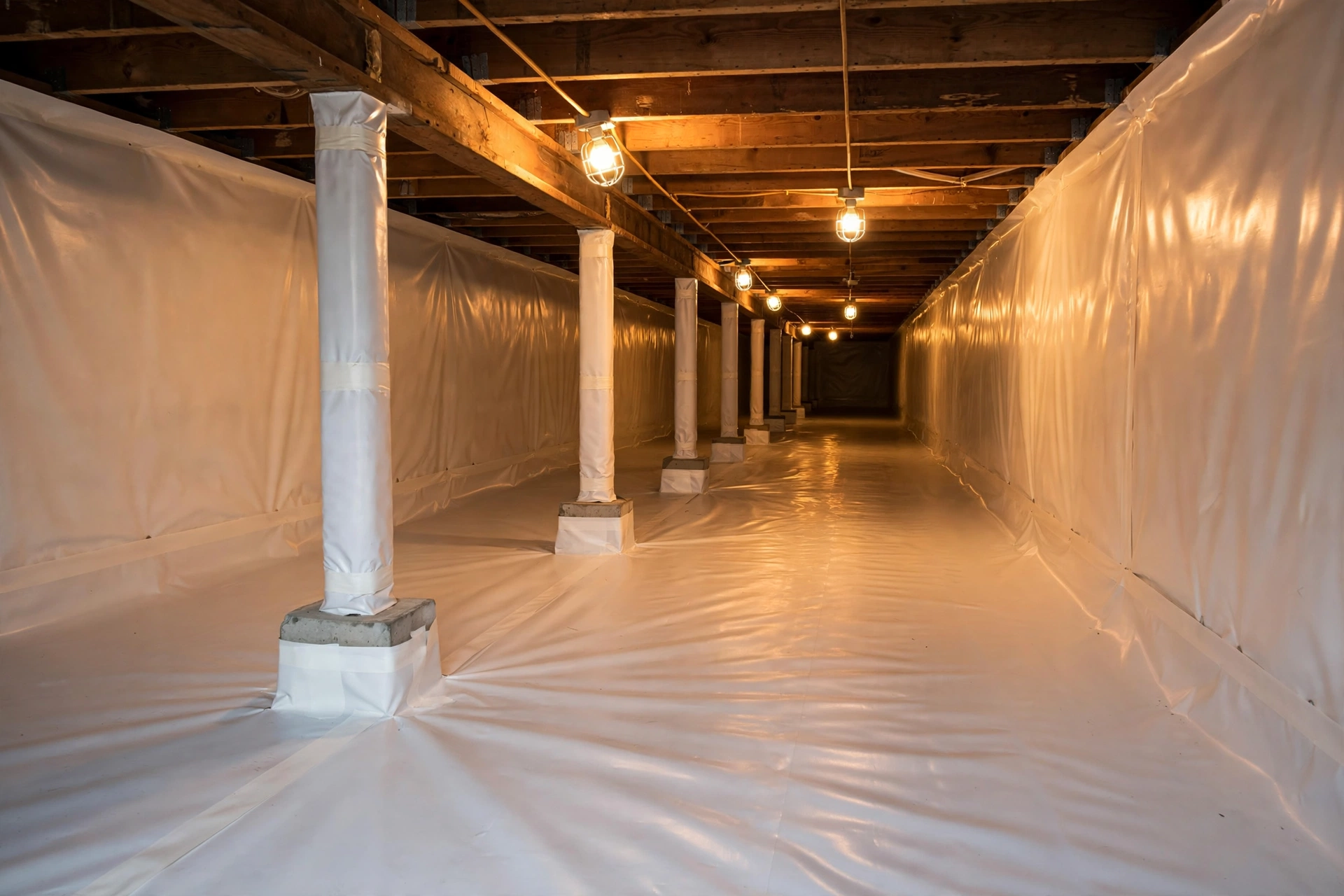
Birmingham's older homes — the 1920s–1970s bungalows of Forest Park, Avondale, and Crestwood — were built with vented crawl spaces that have been breathing humid Alabama air for half a century or more. We encapsulate them properly: sealed, dried, and built to last.
Why Birmingham's Older Homes Are a Special Case
We're based in Hoover, and we spend a lot of our week across the metro in Birmingham proper — and Birmingham's housing stock is unlike anything else we work on. The bungalows and cottages in Forest Park, Avondale, Crestwood, and the surrounding neighborhoods went up between the 1920s and the 1970s, when a vented crawl space was simply how you built a house. Nobody sealed anything. Nobody conditioned the air. The floor framing went in raw, the vents went in open, and the house has been sitting over damp ground ever since.
What we find under those homes is predictable in pattern but always specific in detail: original floor joists that have absorbed decades of seasonal moisture cycling, sill plates softened where they meet the foundation, and — in the oldest homes — framing lumber from an era before pressure-treated sills were standard. These aren't failures. They're the honest result of 50 to 100 years of a building method that assumed dry air.
Mixed soil, mixed foundations, mixed surprises
Birmingham sits at the tail end of the Appalachians, which means the ground under the metro is less uniform than Hoover's clay belt. We see red clay in some neighborhoods, rocky and shale-heavy soil in others — particularly as you move toward the Jones Valley and the ridges. That matters because water behaves differently in each: clay holds it against your foundation, rocky soil channels it along unpredictable paths. A proper inspection in Birmingham starts with reading the ground, not just the crawl space.
The termite factor
Birmingham has one of the heaviest termite pressures in the state — Formosan and Eastern subterranean termites both thrive here. Most older Birmingham homes carry a termite bond, and here's what matters for encapsulation: the barrier must stop 3–4 inches below the sill plate to leave a visible inspection gap. We've seen DIY and out-of-town jobs where the liner runs straight up to the sill, voiding the termite bond and hiding activity. We install to preserve your bond, and we coordinate with your pest company when needed.
Questions Birmingham Homeowners Ask Us
My Birmingham bungalow has stood for 80 years — does it really need encapsulation now?
Standing isn't the same as healthy. An 80-year-old bungalow can be structurally standing while its floor framing quietly loses strength to decades of moisture cycling — and encapsulation stops that clock.
The honest answer depends on what we measure. We take wood-moisture readings on every inspection: below 16% with no mold history, and we'll tell you to leave it alone. Above 19–20%, or with visible fungal growth, and the framing is actively degrading — encapsulation plus remediation is the fix. Age alone doesn't decide it; current conditions do.
Will encapsulation interfere with my termite bond?
Not when it's installed correctly. We leave the required 3–4 inch inspection gap between the top of the wall liner and the sill plate, so your termite tech can still see the foundation wall.
This is actually a reason to hire a local specialist rather than a general handyman or an out-of-state crew. Birmingham's termite pressure means your bond is valuable — a careless liner install that covers the inspection zone can complicate renewals. We do this detail on every job, and we're happy to talk to your pest control company before we start.
Why hire a Hoover company instead of someone in Birmingham?
Because crawl space work is all we do, and the metro is our whole service area. Most Birmingham "waterproofing" results are foundation companies for whom crawl spaces are a side line, or national dealer networks selling a franchise system.
We're fifteen minutes from Forest Park. We don't charge a trip fee anywhere in the metro, our inspections are free with photos, and every system we install is designed for the specific house — not pulled from a franchise playbook. Specialization is the whole point.
My home has a stone foundation — can it still be encapsulated?
Yes, and some of our most satisfying jobs are Birmingham stone and brick foundations from the 1920s–40s. They seal up beautifully — they just need a different approach than poured concrete.
Older masonry is uneven and porous, so we pay extra attention to sealing the wall-to-liner transition and managing any moisture wicking through the masonry itself. It takes more care, not different physics. If a contractor tells you stone foundations "can't" be encapsulated, that's a skill gap, not a fact.
What Encapsulation Costs in Birmingham
Older Birmingham homes tend to land in the $5,000–$15,000 range for a full system. Three things push Birmingham jobs around within that range:
| Factor | How it affects Birmingham pricing |
|---|---|
| Framing condition | Decades-old joists often need sistering or sill repair before sealing — structural work is the biggest variable on older homes |
| Crawl space height & access | Many bungalows have tight 18–24" clearances; low access slows the work and adds labor |
| Mold history | Long-vented spaces frequently need remediation first; this is priced separately and itemized |
A smaller, cleaner 1950s ranch in Crestwood might land near $6,000–$8,000; a 1920s Forest Park bungalow needing structural repair plus full encapsulation can reach $12,000–$15,000. Every quote we write is itemized line by line — see exactly how we price each component.
What to Expect on a Birmingham Job
Older homes add steps, and we don't skip them. After inspection and moisture mapping, we handle any structural repair first — sistering joists, replacing rotted sills — because sealing a compromised structure just hides the problem. Then the standard system goes in: debris cleanout, mold remediation if needed, sealed vents, 20-mil floor barrier and 12-mil wall liner, and a commercial dehumidifier holding 45–55% humidity. On stone and brick foundations, we take extra time at the wall transitions. Most Birmingham jobs run 3–5 days given the added repair work.
- Termite-bond-safe install with proper inspection gap
- Structural repairs completed before any sealing
- Photos before, during, and after — yours to keep
- No trip fee anywhere in the Birmingham metro
Birmingham Encapsulation FAQs
Do you serve all Birmingham neighborhoods?
Yes — Forest Park, Avondale, Crestwood, Highland Park, Southside, East Lake, and everywhere in between, plus the full metro.
We're based in Hoover, roughly 15 minutes from most Birmingham neighborhoods, and there's no trip fee. If you're inside the Birmingham metro, you're in our service area.
My home was built in the 1920s with no vapor barrier at all. Is that worse?
It means the framing has had maximum moisture exposure — but it also means encapsulation delivers maximum improvement. These are often our most dramatic transformations.
Homes that never had any barrier frequently show the clearest before-and-after in wood-moisture readings. The framing has survived this long; our job is to make sure it survives the next 50 years too.
Can you work around old plumbing and wiring in the crawl space?
Yes — we seal around every penetration: pipes, wires, and ducts get cut-and-sealed liner boots, not gaps.
Older Birmingham homes often have generations of added plumbing and wiring running through the crawl space. We map every penetration during inspection and seal each one. It's slower work, but gaps are where encapsulation systems fail.
How do I know if my bungalow's framing is still sound?
Wood-moisture readings and a probe test — that's the honest answer, and it's what our free inspection includes.
Surface appearance lies: joists can look fine and be soft inside, or look rough and still be structurally solid. We measure moisture content and physically probe suspect areas, then show you photos. No guessing, no scare tactics.
Get Your Free Birmingham Inspection
Older homes deserve a specialist's eye. We'll crawl it, photograph it, measure it, and give you a straight answer — whether that's a full system or "you're fine, call us in five years."
- Free inspection with photos anywhere in the metro
- Wood-moisture readings on every visit
- Itemized quote — every line visible
- Termite-bond-safe installation guaranteed
Prefer to talk? (205) 208-7286