Crawl Space Encapsulation in Bluff Park, AL
Bluff Park's 1960s–1980s ranch homes have some of the oldest original crawl spaces in Hoover — thin builder barriers long since disintegrated, floor framing that's been cycling moisture for 40+ years. We know exactly what decades of deferred maintenance look like under these houses, and how to fix it.
The Deferred-Maintenance Neighborhood
Bluff Park is one of Hoover's original neighborhoods, and its housing stock shows it — in the best and most honest way. The ranch homes here went up in the 1960s through the 1980s, solid brick construction on crawl space foundations. They were well built. But their crawl spaces have now endured four to six decades of Alabama humidity, and almost none of them have ever been touched.
Here's what that timeline means in practice. The original vapor barrier — if one was installed at all — was likely a thin 6-mil sheet, unsealed at the seams. That plastic had a functional life of maybe 15–20 years. It has been gone for decades. Since then, the bare ground has been breathing moisture straight into the framing every summer, and every winter the cycle has repeated. When we inspect Bluff Park crawl spaces, we're usually looking at the cumulative result of 40 years of that cycle.
What 40-year-old crawl spaces actually look like
No drama, just physics: floor joists with surface mold staining, insulation that's sagged or fallen in sections (wet fiberglass loses its grip and its R-value), and sill plates that probe soft at the corners where water has wicked in. The homes are still standing — ranch framing is forgiving — but the margin is thinner than the homeowner thinks. This is the neighborhood where "we've been meaning to deal with that musty smell" is practically a greeting.
Settling on clay, ranch-style
Bluff Park sits on the same expansive Shelby County clay as the rest of Hoover, and these older foundations have had the longest time to ride the swell-shrink cycle. We see the signs: stair-step cracks in older brick veneer, interior doors that stick seasonally, and crawl spaces where the grade has shifted enough to pond water in low spots that used to drain. None of this is an emergency — it's geology on a 50-year timeline. But it's exactly why encapsulation here usually starts with regrading the crawl space floor and confirming drainage before anything gets sealed.
Questions Bluff Park Homeowners Ask Us
My ranch has been fine for 40 years — why fix the crawl space now?
"Fine" usually means "nothing has collapsed." But 40 years of moisture cycling degrades framing gradually — encapsulation now protects the decades your home still has ahead of it.
Think of it as maintenance timing, not emergency repair. The framing that has survived 40 years can survive 40 more if the moisture stops. But every additional year of cycling narrows the margin. We measure current wood moisture and probe the sills; if the numbers are good, we'll say so. If they're not, sooner is cheaper than later — remediation plus encapsulation today beats structural repair plus encapsulation in five years.
There's old insulation falling down under my house. Do I need new insulation too?
Almost certainly the old floor insulation needs to come out — but you likely don't want the same kind put back. In a sealed crawl space, we insulate the walls, not the floor.
Fiberglass batts between joists are a moisture sponge; that's why they're sagging. Once we encapsulate, the crawl space becomes conditioned space, and the right move is rigid insulation on the foundation walls per code. It's a better thermal result and it can't fall down. The failed batts come out as part of our cleanout.
Will encapsulation help with the musty smell that's been there for years?
Yes — and in Bluff Park homes, the improvement is usually dramatic, because the odor source is decades of accumulated microbial growth on damp framing.
That long-standing mustiness is mold and mildew metabolizing on moist wood — up to half your first-floor air comes from the crawl space, so you've been breathing it for years. Our process remediates the growth, treats the wood, then seals and dries the space. Homeowners typically notice the difference within the first week.
My home is brick — doesn't that protect the crawl space?
Brick veneer protects the walls above grade. It does nothing for the crawl space — moisture comes from the ground and the air, not through the brick.
This is a common Bluff Park misconception, because the homes look so solid from the street. But the crawl space doesn't care about the veneer: bare ground evaporates moisture upward, humid air enters through the vents, and the framing absorbs both. The brick will outlive us all; the floor system needs the help.
What Encapsulation Costs in Bluff Park
Bluff Park jobs typically land between $5,000–$12,000. The range reflects how much deferred maintenance we're unwinding:
| Factor | How it affects Bluff Park pricing |
|---|---|
| Cleanout volume | Decades of debris, fallen insulation, and old barrier remnants — cleanout is a bigger line item here than in newer neighborhoods |
| Mold remediation | Long-untouched spaces frequently need treatment; priced per scope and itemized separately |
| Floor regrading | Settled crawl space floors often need regrading for drainage before sealing — common in 1960s–70s ranches |
A 1970s ranch with moderate mold and standard cleanout might land $7,000–$9,000; one needing extensive remediation plus regrading can reach $10,000–$12,000. As always, every component is itemized in our quotes — see the full breakdown.
What to Expect on a Bluff Park Job
Bluff Park jobs start heavier on the front end than newer homes: full cleanout of failed insulation and debris, mold remediation and wood treatment where needed, and crawl space floor regrading if settling has created ponding spots. Only then do we seal — vents closed, 20-mil floor barrier, 12-mil wall liner, wall insulation instead of floor batts, and a commercial dehumidifier. Most Bluff Park systems take 3–5 days because the prep work is the job.
- Complete removal of failed insulation and debris
- Mold remediation with wood treatment — never sealed in
- Floor regrading for positive drainage before sealing
- Wall insulation (not floor batts) per code
Bluff Park Encapsulation FAQs
How long does a Bluff Park encapsulation take?
Typically 3–5 days. The cleanout and remediation phases take longer here than in newer homes — that's normal and it's where the value is.
Day one is usually cleanout and remediation; days two through four are sealing, liner, insulation, and dehumidifier; final day is verification readings and documentation. We don't rush the prep — it's the foundation everything else depends on.
Will you find structural damage under my 1960s ranch?
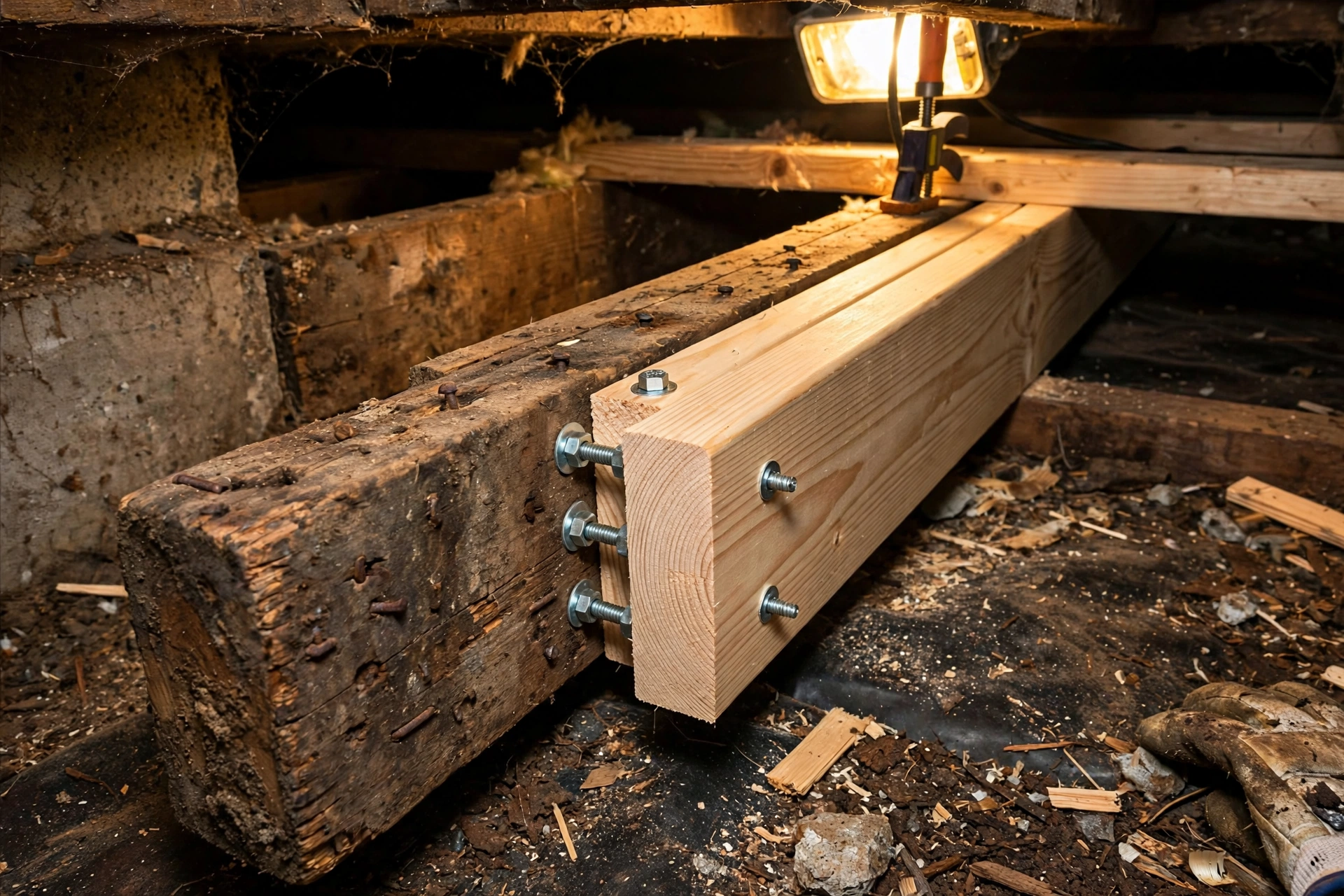
Sometimes, and when we do, we fix it before sealing. Sistering a joist or replacing a sill section is routine work for us.
Here's our rule: we never seal over compromised framing. If probing reveals soft sills or sagging joists, that repair becomes line one of your quote — priced upfront, done first, photographed throughout.
My neighbor encapsulated and said it was the best money they spent. Is that typical?
For Bluff Park's housing stock, yes — the before-and-after is starkest in homes that have never been touched, because the starting point is 40 years of moisture.
The musty smell disappearing, floors feeling solid, summer humidity dropping indoors — these are the consistent reports. But we'd rather earn it on your house than trade on your neighbor's: the free inspection will tell us exactly what yours needs.
Do I need to move out during the work?
No. All work happens in the crawl space and we seal our work area — you live normally upstairs.
You'll hear us coming and going through the access point, and remediation days have some equipment noise, but there's no reason to leave. Pets should stay clear of the access area, and that's about it.
Get Your Free Bluff Park Inspection
Four decades of deferred maintenance is our specialty, not our obstacle. We'll show you exactly what's under there and exactly what it takes to fix it — itemized, no pressure.
- Photos of everything — the honest condition
- Wood-moisture readings, not guesses
- Itemized quote with remediation broken out
- Straight answer if the timing isn't right yet
Prefer to talk? (205) 208-7286